Cycling Wasteland No. 2 is dealing with a major obstacle for cyclists in Central London. This one annoys me particularly because it has been built on purpose and it is utterly unnecessary. It’s not only a missed opportunity but a man made nuisance for cyclists.
I’m ranting against the fact that Lloyd Baker Street is a one way street.
Probably you’ve never heard about this street. It’s a small and quiet road in Clerkenwell crossing Amwell Street. It’s an important street for cyclists who want to go from Angel towards Tottenham Court Road.
Lloyd Baker Street
As you can see on the map the most direct route on quite roads from Angel towards the West leads through this tiny street. Lloyd Baker Street connects the cycle path on Tavistock Torrington with Myddelton Square and the triangle St. John Street / Goswell Road / City Road.
Again, as with Bath Street, I’m only talking about 50 meters of road. After having entered Lloyd Baker Street one can turn right on Lloyd Street and then left on Lloyd Square / Wharton Street.
However, a law abiding cyclist coming from Myddelton Square who wants to get to Ampton Street (which leads to the Tavistock-Torrington cycle path) would have to make a significant detour. I suspect that a lot of cyclists just stick to busy main roads.
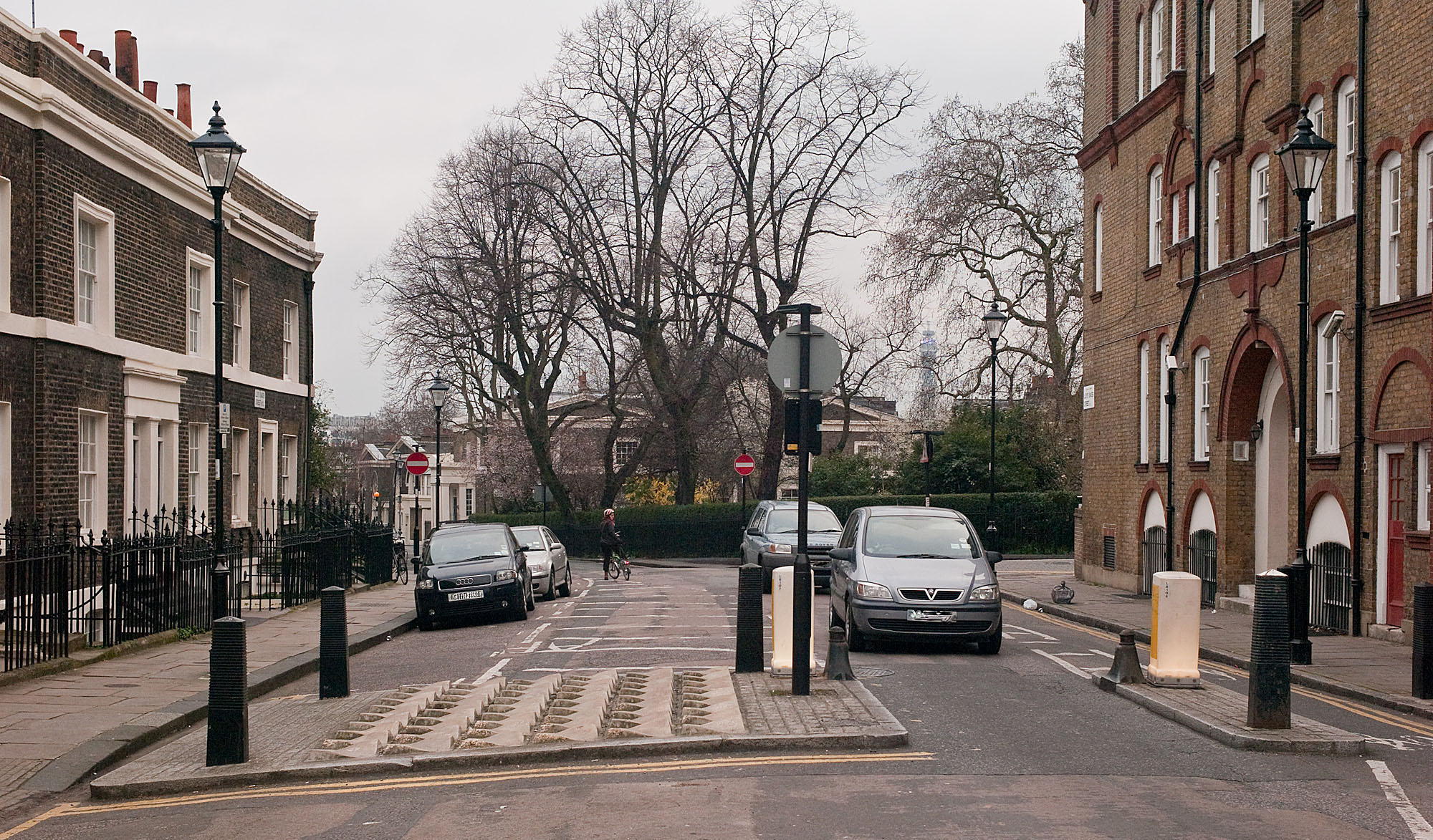
As you can see on the second picture there is a nasty barrier which currently blocks westbound traffic. However there is absolutely enough room to build a contraflow system.
A closer view. In front of the second traffic signs we're making a right turn.
The only sensible argument opening Lloyd Baker Street for westbound cyclists could be that the next junction (Wharton Street / King’s Cross Road) is a little bit difficult to cross. It is a little bit hard to see the traffic on King’s Cross Road while standing on Wharton Street. If this was a concern, it could easily be addressed: just install traffic lights at this junction.
A lot of our friends are surprised that we don’t have car here in London. Even those who are living in London themselves. Well, it’s not only that you don’t need it. It really would be a burden. “But how do you manage the weekend shopping?” usually is the next question. The answer is rather easy: We got our Bromptons.
... and afterwards (and That
Time and again I’m myself stunned by the fact how much stuff you can carry on those tiny little folding bicycles. Probably things would be more complicated if we had kids. But a typical two person household in central London can easily sustain itself without any car.
Major Boris Johnson has pledged to ignite a “cycling revolution” in London. The city is spending million of pounds on the cycling hire scheme and “cycling superhighways”. However, there are a lot of small things which could be done to significantly improve safety and convenience for cyclists in London. In this section named “London’s Cycling Wasteland” I’m going to present some examples. They are coming from my own daily experiences on London roads.
Where?
I’m starting with an example that annoys me each time I’m cycling towards the City from Highbury. It is all about the northern end of Bath Street in Clerkenwell and the Old Street roundabout aka “Junction of Death” in Shoreditch.
The collision has reignited safety concerns over the busy roundabout – one of the worst for crashes in the capital. Thousands of cars, cyclists and lorries use it every day. Cyclist Leo Chapman, who lives nearby in Finsbury, said: “I wouldn’t go around that roundabout, it is just too dangerous. “You could easily get squeezed by somebody and there are too many lanes.”
He suggested cyclists avoid the roundabout by using Shepherdess Walk, Bath Street and Bunhill Row.Charlie Lloyd, cycling development officer of London Cycling Campaign, told the Gazette: “The roundabout has a bad track record. It is among the top three for crashes in London.”
The northern end of Bath Street (across the street), seen from Shepherdess Walk. Southbound cyclists are not allows to go straight on because Bath Street is a one way steet.
Leo is talking about this area and he is absolutely right: In theory Shepherdess Walk, Bath Street and Bunhill Row are perfect for avoiding the Old Street roundabout. Legally, however, this works only for northbound cyclists. Southbound cyclists, unfortunately have to break the law if they want to avoid the “Junction of Death” – the northern end of Bath Street currently is a one way street without any contraflow system.
I’ve just stumbled upon an interesting blog post by David Hembrow on the Boris Bike scheme in London. He’s rather critical with regard to the PR by Transport for London:
They’re continuing with the same style of writing that they established a while back. This can be summed up as trying to baffle the reader by quoting what sounds like huge numbers.
Oliver O'Brien's ingenious visualization of the Bloris bike scheme
TfL recently announced that 2.5 million journey’s have been made since the launch of the scheme in August 2010. David writes:
The numbers sound great, but actually if you look closely at them you quickly see that this is not actually very impressive at all. London has a population of 8 M people. Between them, they make around 20 million journeys per day. If these journeys had all been made on just one day (requiring each bike to be used an impossible 416 times), then even that would make up only 12% of total journeys in the city. However, actually it took half a year, 182 days, for this many journeys to be made. The total usage equates to only around 0.07% of the total journeys in the city. On average, Londoners are using these bikes not once per day, not once per week or once per month, but about once every 18 months.
David has a point, of course. There is a lot of sales patter in the communication of TfL and, no doubt, they are trying to baffle people with big numbers.
However, I think his calculations are partly misleading because he is comparing apples to oranges.
Road Safety really is an honourable cause. In Western countries many more people die because of traffic accidents than because of terrorism. The majority of the deaths are related to motorized traffic. Unfortunately, however, the perception that cycling is risky turns a lot of people off. “Isn’t it dangerous?” is the most frequent question I’m being asked with regard to cycling in London. Of course, as always, stuff happens. But by and large, the health benefits of cycling are much bigger than the risks, as the Cycling Touring Club argues. Additionally, the more cycles are on the roads, the safer cycling gets. The CTC calls this the “safety in numbers” effect.
Given this background a new campaign called “Ghoststreet” by the Newcastle City Council is really outrageous. The claimed aim of the campaign is to raise awareness about road safety. In fact, however, it is scaremongering at its best. Or, as Matt Jones rightly asserts in an open letter to Newcastle City Council:
this campaign [..] seems out of place and only serves to discourage people from cycling or walking.
In his first inaugural address in 1932 Franklin D. Roosevelt made the famous point that “we have nothing to fear but fear itself”. This is not only true in economic recessions, it’s also true with regard to cycling as well. “And Newcastle City Council”, one might add.
“The Independent” has recently published some interesting facts about London’s Barclay’s Cycle Hire scheme. Unfortunately, my dear colleagues did a rather poor job interpreting those figures.
Boris Bikes at Southwark Street in London (Photo by Green Lane from Wikimedia Commons)
According to the Independent, which draws on figures from Transport for London (TfL) since the launch of the “Boris Bikes” in August 2010:
seven million miles have been cycled
100000 people have signed up (I’m one of them, BTW)
3566 bikes (30 per day) have had to be repaired
180 bikes have been vandalised
10 bikes have been stolen
To me, these figures underscore the huge success of the scheme given that here had been widespread concerns about theft and vandalism prior to the launch of the cycling hire scheme. But since only bad news are good news, my dear colleagues at the “Independent” are trying to give a negative spin to those figures:
Two-thirds of London’s “Boris bikes” have had to undergo repairs in their first six months of operation. (…) Critics claimed that the high rate of repairs was a result of TfL opting for “unwieldy machines” over more sophisticated bikes.
I think this is quite an unfair and distorted interpretation of those numbers. Are 3566 repairs since August 2010 really resembling a “high rate of repairs”? As we have also learned by the TfL figures, the Boris bikes have been done 7 million miles since August. This means there are on average 0.0005 repairs per mile traveled (In fact the real figure is much lower because we’re only talking about the bikes which actually had an issues).
I’ve done around 1500 miles on my Brompton since August 2010 and had four punctures which equals 0.0027 repairs per mile. Perhaps I should use the Boris bikes more often…
This is my most recent bike and the one I’m using every single day. It’s a customized 6-speed Brompton. My general views on folders in general and Bromptons in particular are being discussed here. Configuring your Brompton isn’t particularily easy because the manufacturer offers a myriad of different options regarding the gearing, the handlebar and a lot of other things. Below, I would like to discuss the different options and explain my personal choices (M6L-X). I’ve done around 2000 miles on it in the first year, the longest ride was 40 miles.
My Brompton, ready to go
Gearing:
My bike is equipped with the new 6-speed “BWR” gearing. BWR stands for “Brompton Wide Range”. The gearing is a combination of a 3-speed hub gear with rather wide gear ratios and a 2-speed derailleur gear which helps to smooth the gaps between the three gears.
Before buying the bike I was also considering the 2-speed version which does not come with any hub gear but just with the derailleur because I was temped by the weight saves. The 2-speed adds just 188g compared to the naked bike while the 6-speed adds 920g. Weight is an issue with folding bicycles because you will carry the bike quite often. I ruled out the 3-speed gearing rightaway because it almost weights as much as the 6-speed version (3-speed adds 740g).
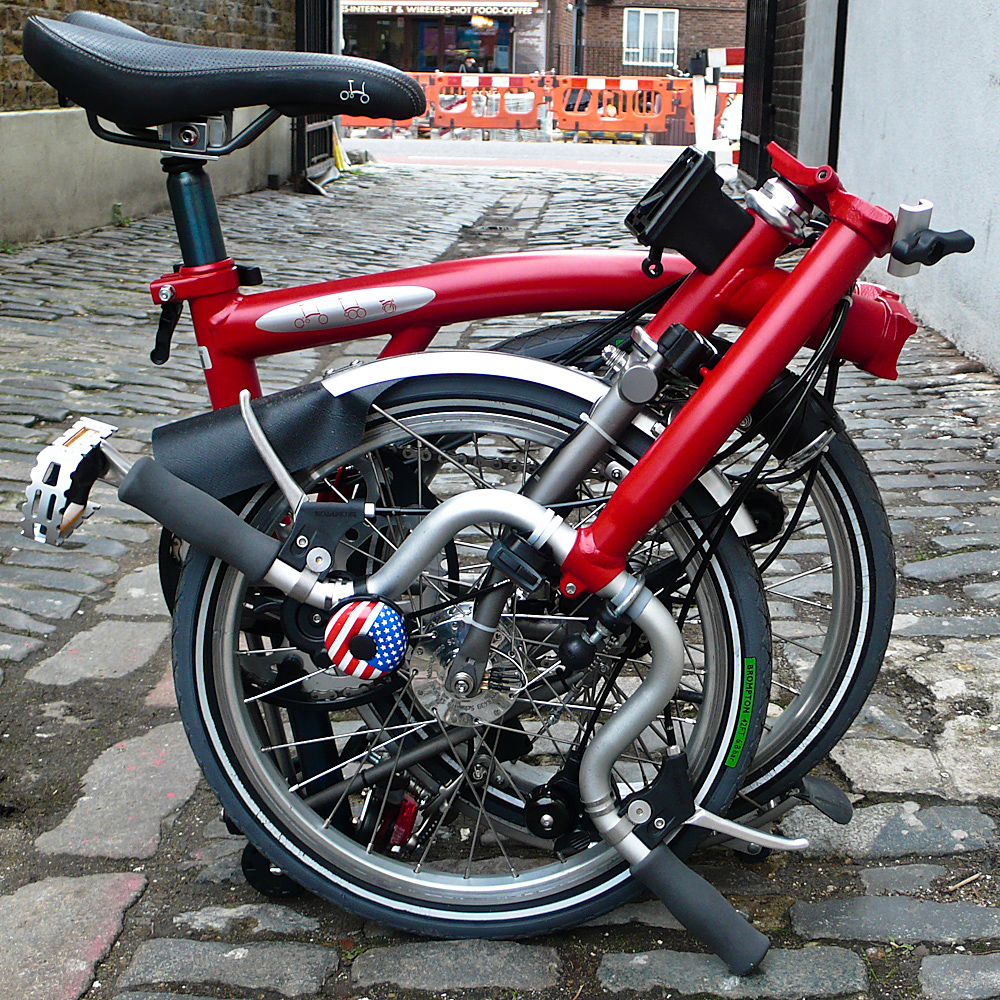
The folded bike
Which gearing is best for you depends mainly on your personal tastes and where you are going to use the bike. If you’re living in a completely flat region and are sure that don’t want to use the bike in hilly areas at all the 2-speed version (or even no gearing at all) is best. However, if you live in a hilly area and/or want to have a bike which is really versatile I’d strongly recommend the BWR-6-speed.
Handlebars
I decided for the classical “M”-type handlebar. The “P”-type is heavier, and the “S”-type does only work with a very limited range of bags. (The luggage system of the brompton is ingenious, I’ll come back to that later.)
Lightweight version
I opted for the lightweight version of the bike. Titanium is used instead of steel for several parts. The bike weights one kilogram less. That’s a lot given you have to carry it frequently.
Lighting
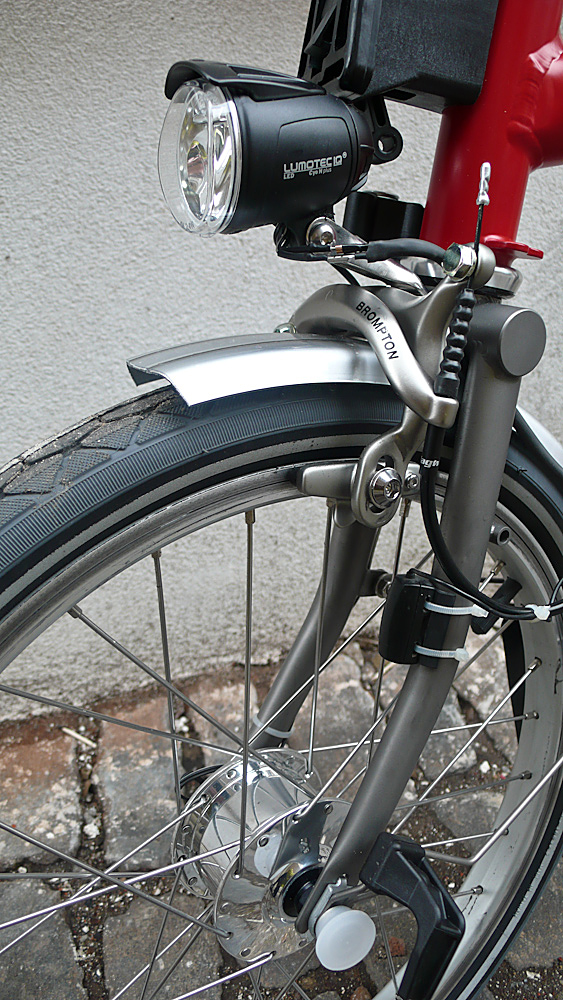
The SON hub dynamo and the Cyo LED headlight
I took the Schmidt SON hub dynamo. The best and most beautiful lighting option, unfortunately the most expensive as well. The Shimano hub dynamo wasn’t introduced when I bought the bike but it is heavier than the Schmidt and has a lower efficiency. The big advantage of a hub dynamo over battery lights is that you don’t have to thing about your lighting. You don’t have any hassle with batteries which are running out and you have a very good front light which is highly visible (much better than those flashing LED lights). The SON is so efficient that you do not notice any difference when the lights are on. This is why I’m always riding with the lights on. It’s an additional layer of safety.
Rack
I decided against a rack. This is the only thing I would reconsider if I had to buy a new Brompton. Without a rack the bike is more beautiful and weights less. On the other hand, the handling of the folded bike is easier when you have a rack (and those so called “Easy Wheels”). Then, the folded bike almost becomes a skateboard when it is folded. The second advantage of the rack is that you can easily carry a sixpack of Evian on it.
Update: After 1.5 years, I gave in and mounted a rack to the bike.
Modifications
Well, compared to what I’ve changed at my other bikes there are not much modifications on my Brompton. When I bought the bike it came with a rather crappy halogen headlight. I replaced it with a 60 lux LED headlight by Busch and Müller (“Lumotec Cyo 60”) which is incredibly bright and super reliable: I’ll never have any trouble with blown bulbs anymore. Nowadays if you order a SON hub dynamo the bike comes with a similar headlamp straight from the factory. I also replaced the rear light with a better one by Busch and Müller.
I removed the Brompton stickers on the main frame because due to tear and wear the became shabby very soon. Additionally I mounted a GPS holder and a bike computer, that’s it.
Buying a folding bicycle was one of the first things I did when I moved from Germany to London in 2009. I went for a Brompton which I use on a daily basis ever since. I’ve done 2000 miles on it in the first year and I absolutely love the bike. I think Bromptons are the ultimate machine for getting around in London (and any other town, in fact).
In this post I would like to discuss my personal views on the pros of cons of folding bicycle in general and the Brompton in particular.
Why a folder?
Storage
The most obvious reason for a folding bicycle in a city like London is that space comes at a premium. In Germany storing a bike securely at home usually is not an issue at all. You either put it in the cellar, in the backyard or just chain it to a lamppost. In London, however, there usually are no such options.
When we were looking for a flat we had more than 40 viewings. Only two or three properties offered decent bike parking options. Since bike theft is a huge issue here this basically means that you have to store the bike in your flat. And this is much more convenient with a folding bicycle.
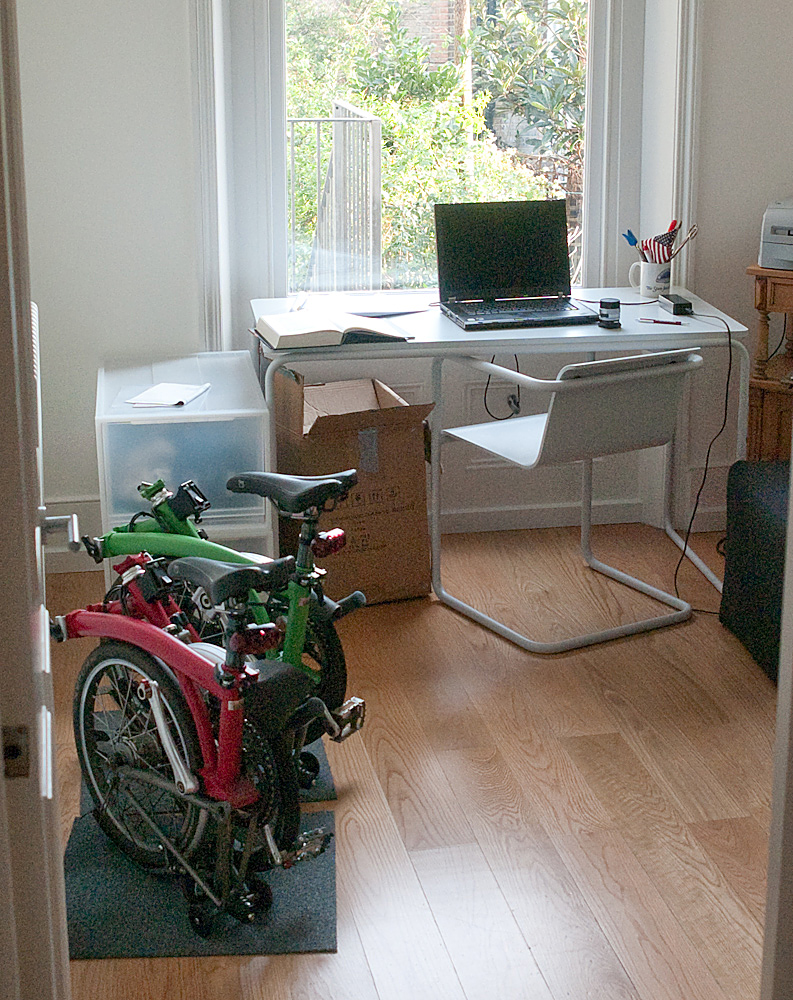
Brompton parking at home
Theft
The second big advantage of a folder is related to the first one. Bike theft is not an issue I have to worry about anymore. I just take the bike with me wherever I go. I almost never carry a lock when I’m riding the Brompton. In the office it sits below my desk, in the supermarket I put it into the shopping cart, in the theatre I leave it at the cloakroom.
My Brompton has been at the Bank of England, the London School of Economics, the British Library, Tate Modern, the Barbican, the headquarters of Royal Bank of Scotland and HSBC, top-notch restaurants and hotels like Locanda Locatelli, the Halkin Hotel and the Waldorf Hilton as well as an uncounted number of pubs. In the first twelve month I’m living with Brompton I encounterd one single occasion where I was unable to take the bike with me – in the National Portrait Gallery. There, the cloakroom does not accept folding bicycles because they claim that they are too big (That’s rubbish, of course!). I only carry a light cable and a small padlock when I’m taking the bike on trains.
Mobility
Brompton Ltd. advertisements claim that you’re not just getting a bike but a different form of personal transport. To be honest when I was ordering the bike I thought that this was just the usual marketing banter. Since I’m using it I’ve found out that they are just dead right. The bike virtually vanishes when you fold i. This is why you can take it with you almost everywhere you go. Combining cycling with train rides or car journeys becomes much easier. That’s why folders are so popular with commuters. Fortunately I don’t have such a long commute to work but when I have appointments in different cities I usually take the bike with me. My Brompton accompanied me on trains to Manchester and Bruxelles, for example. There, I did not have to take a cab but just cycled from the station to my meetings.







 Cycling Intelligence