A lot of our friends are surprised that we don’t have car here in London. Even those who are living in London themselves. Well, it’s not only that you don’t need it. It really would be a burden. “But how do you manage the weekend shopping?” usually is the next question. The answer is rather easy: We got our Bromptons.
... and afterwards (and That
Time and again I’m myself stunned by the fact how much stuff you can carry on those tiny little folding bicycles. Probably things would be more complicated if we had kids. But a typical two person household in central London can easily sustain itself without any car.
Major Boris Johnson has pledged to ignite a “cycling revolution” in London. The city is spending million of pounds on the cycling hire scheme and “cycling superhighways”. However, there are a lot of small things which could be done to significantly improve safety and convenience for cyclists in London. In this section named “London’s Cycling Wasteland” I’m going to present some examples. They are coming from my own daily experiences on London roads.
Where?
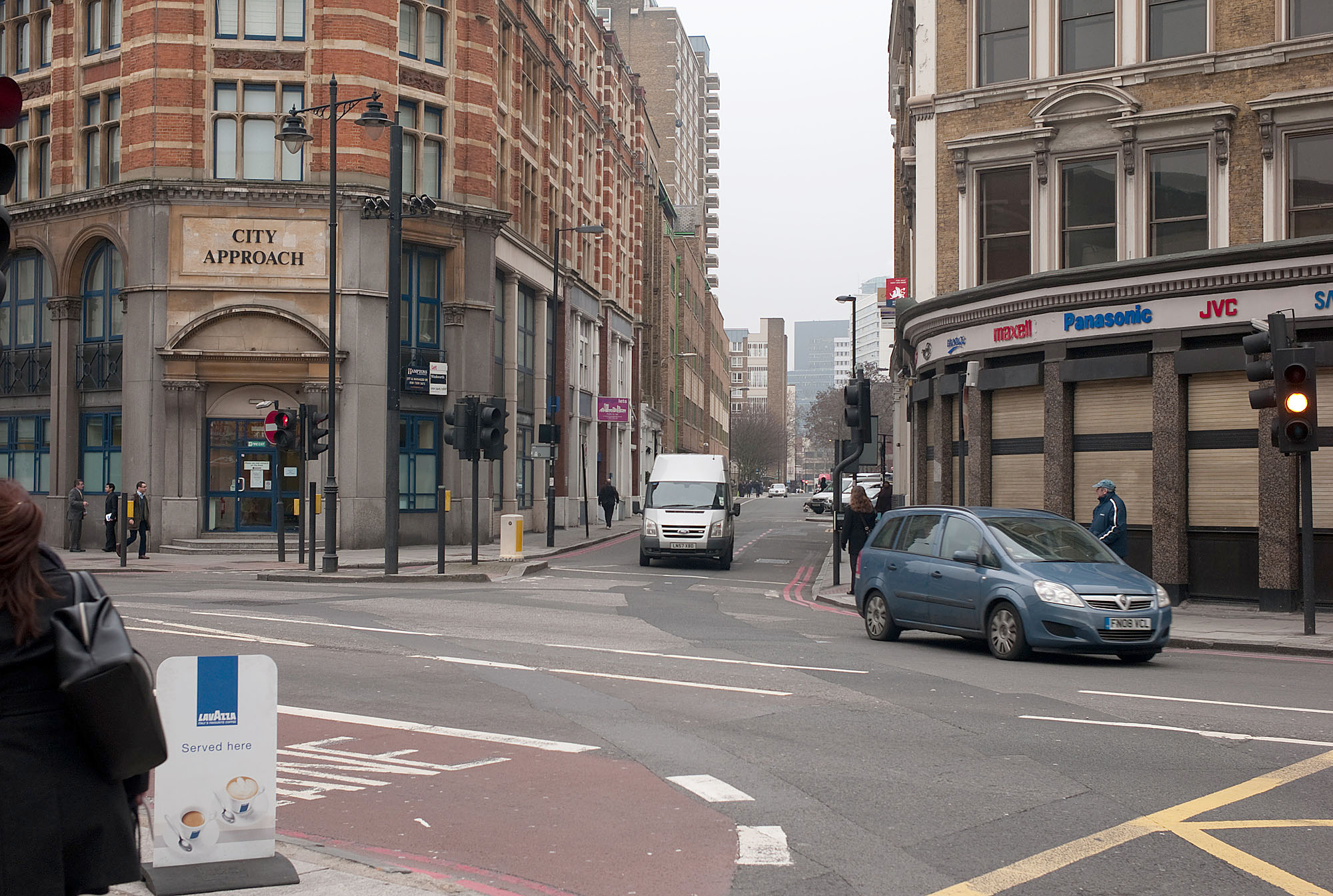
I’m starting with an example that annoys me each time I’m cycling towards the City from Highbury. It is all about the northern end of Bath Street in Clerkenwell and the Old Street roundabout aka “Junction of Death” in Shoreditch.
The collision has reignited safety concerns over the busy roundabout – one of the worst for crashes in the capital. Thousands of cars, cyclists and lorries use it every day. Cyclist Leo Chapman, who lives nearby in Finsbury, said: “I wouldn’t go around that roundabout, it is just too dangerous. “You could easily get squeezed by somebody and there are too many lanes.”
He suggested cyclists avoid the roundabout by using Shepherdess Walk, Bath Street and Bunhill Row.Charlie Lloyd, cycling development officer of London Cycling Campaign, told the Gazette: “The roundabout has a bad track record. It is among the top three for crashes in London.”
The northern end of Bath Street (across the street), seen from Shepherdess Walk. Southbound cyclists are not allows to go straight on because Bath Street is a one way steet.
Leo is talking about this area and he is absolutely right: In theory Shepherdess Walk, Bath Street and Bunhill Row are perfect for avoiding the Old Street roundabout. Legally, however, this works only for northbound cyclists. Southbound cyclists, unfortunately have to break the law if they want to avoid the “Junction of Death” – the northern end of Bath Street currently is a one way street without any contraflow system.
I’ve just stumbled upon an interesting blog post by David Hembrow on the Boris Bike scheme in London. He’s rather critical with regard to the PR by Transport for London:
They’re continuing with the same style of writing that they established a while back. This can be summed up as trying to baffle the reader by quoting what sounds like huge numbers.
Oliver O'Brien's ingenious visualization of the Bloris bike scheme
TfL recently announced that 2.5 million journey’s have been made since the launch of the scheme in August 2010. David writes:
The numbers sound great, but actually if you look closely at them you quickly see that this is not actually very impressive at all. London has a population of 8 M people. Between them, they make around 20 million journeys per day. If these journeys had all been made on just one day (requiring each bike to be used an impossible 416 times), then even that would make up only 12% of total journeys in the city. However, actually it took half a year, 182 days, for this many journeys to be made. The total usage equates to only around 0.07% of the total journeys in the city. On average, Londoners are using these bikes not once per day, not once per week or once per month, but about once every 18 months.
David has a point, of course. There is a lot of sales patter in the communication of TfL and, no doubt, they are trying to baffle people with big numbers.
However, I think his calculations are partly misleading because he is comparing apples to oranges.
“The Independent” has recently published some interesting facts about London’s Barclay’s Cycle Hire scheme. Unfortunately, my dear colleagues did a rather poor job interpreting those figures.
Boris Bikes at Southwark Street in London (Photo by Green Lane from Wikimedia Commons)
According to the Independent, which draws on figures from Transport for London (TfL) since the launch of the “Boris Bikes” in August 2010:
seven million miles have been cycled
100000 people have signed up (I’m one of them, BTW)
3566 bikes (30 per day) have had to be repaired
180 bikes have been vandalised
10 bikes have been stolen
To me, these figures underscore the huge success of the scheme given that here had been widespread concerns about theft and vandalism prior to the launch of the cycling hire scheme. But since only bad news are good news, my dear colleagues at the “Independent” are trying to give a negative spin to those figures:
Two-thirds of London’s “Boris bikes” have had to undergo repairs in their first six months of operation. (…) Critics claimed that the high rate of repairs was a result of TfL opting for “unwieldy machines” over more sophisticated bikes.
I think this is quite an unfair and distorted interpretation of those numbers. Are 3566 repairs since August 2010 really resembling a “high rate of repairs”? As we have also learned by the TfL figures, the Boris bikes have been done 7 million miles since August. This means there are on average 0.0005 repairs per mile traveled (In fact the real figure is much lower because we’re only talking about the bikes which actually had an issues).
I’ve done around 1500 miles on my Brompton since August 2010 and had four punctures which equals 0.0027 repairs per mile. Perhaps I should use the Boris bikes more often…




 Cycling Intelligence