My best cycling moments in 2016

With 2016 coming to an end, it’s time to reflect on my cycling year. Overall, I’ve ridden 12856 km over the last twelve months, 419 km less than in 2015. The year did not fully pan out according to my original plans, which involved riding a very hilly 1000km Audax event in Nothern England in the summer. After a very tough 300km Audax in March, I decided to chicken out, and also was on the brink of abandoning my second Randonneur Round the Year attempt. I’m glad that I decided against the Mille Pennines ride, which took part in horrendous weather and saw a very high percentage of riders packing, and I’m also glad that I stuck to the RRtY. I completed my second series in August and started a third one a month later.

Here are my 10 best bike-related moments of 2016. Many thanks to everyone involved, in particular Kat, Gordon, Titus, Eddie, Tim, Mary, Haiko, John W.  and  Andrew.

Bring on 2017!

August: Dessoubre valley
20160828-img_2067


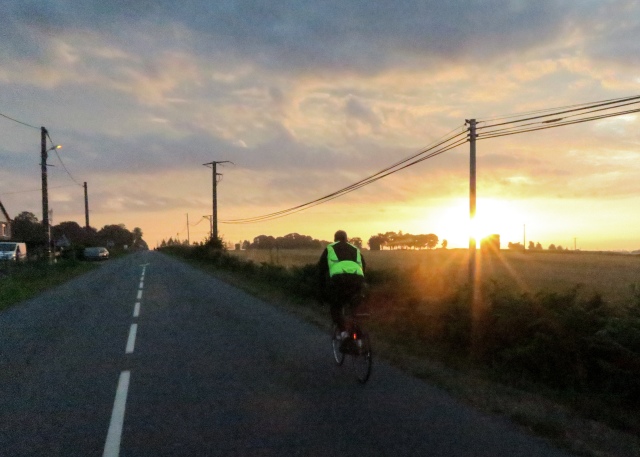
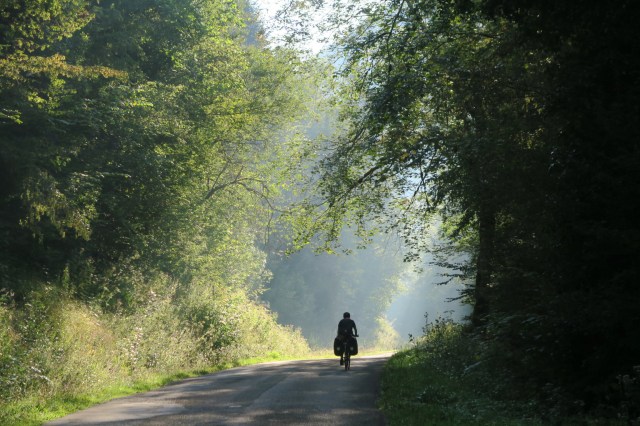
Riding down the D39 from Pierrefontaine-Les-Varans to Staint Hyppolyte in the French Jura in the early morning hours of a hot summer day was just beyond magic. The narrow Dessoubre valley is really fairy-tale stuff.

20160828-img_408920160828-img_2084-2

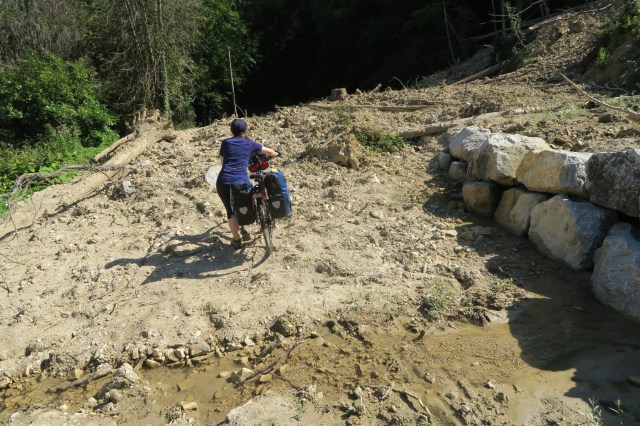
Later that day, we had to carry our bikes through a  road blocked by a landslide, and climbed up a pass into Switzerland. Continue reading “My best cycling moments in 2016”
87 very special hours – my PBP 2015

“Vous-avez fait déjà 1001 km”. It was a beautiful afternoon when I rode past that humble sign. Locals stood by the roadside cheering us on, and I started to cry.

20150816-IMG_1404
Leaving Paris…

Having left Paris 69 hours earlier, I still had 230km ahead of me. But with more than five hours time on hand, I felt pretty confident that – barring disasters – I would make it.

I had expected a lot of suffering on PBP, the 1235 kilometer non-stop bike ride from Paris to Brest and back again: Saddle sours, hot feet, Shermer’s neck, falling asleep on the bike – the internet is full of long-distance rider’s horror stories.

But to my big surprise, I was feeling really strong despite having ridden 1001 km.

20150819-IMG_1508
Morning is breaking (on day 3)

The second half of the ride was actually going better than the first one. I had found my rhythm, had met the perfect cycling companion, and being on my bike had turned into a spiritual experience. I felt like the bike and myself had become one entity. A magic experience I had never had before.

20150818-IMG_1450
Almost half way: the last leg into Brest

This is not to say Paris Brest Brest was a walk in the park. It wasn’t. I had experienced my low-point after about 350 km, about 20 hours or so into the ride.

Continue reading “87 very special hours – my PBP 2015”

My PBP qualification and RRtY in pictures

It’s only a few days to Paris-Brest-Paris. I have been dreaming for more than a decade about taking part in this historic long-distance cycling event, but always considered completely it out of reach. Not just cycling 1230km in 90 hours. Just the challenge of qualification –  doing four long-distance rides of  200km, 300km, 400km and 600km in the same year and within a certain time limit – seemed way too big.

Well, after upping my cycling significantly in recent years and successfully starting to lose weight in January 2014, I began seriously pondering to “do PBP” in 2015. As a preparation, I started a challenge called RRtY. This stands for  Randonneur Round the Year and means doing  at least one 200k ride in 12 consecutive months. I completed it last Friday with a 200k ride after work.

Here’s my RRtY and PBP qualification year in review.

My Audaxing career started in earnest in July 2014, when I did a 325k  ride from Lille in France to Oberhausen in Germany. At the time, it as by far the longest ride I had ever done so far.

I took the Moulton on the Eurostar, spend the night at a hotel in Lille and headed off 4.30am. Continue reading “My PBP qualification and RRtY in pictures”

Paris-Brest-Paris 2015 – my kit list

It’s less than four weeks to Paris-Brest-Paris, a historic long-distance cycling event . My big dream of taking part is eventually coming true is year. I’ll be rider J208, trying to ride 1230km (769 miles) in less than 90 hours.

I used the qualifiers and other long-distance rides to test and optimize my equipment. Other people’s kit lists proved also very helpful – in particular Marcus Jackon-Baker’s.

Including bags, but excluding food, I’ll be hauling about 6 kilos of luggage across Brittany.

Here’s a detailled outline of my kit.

Bags

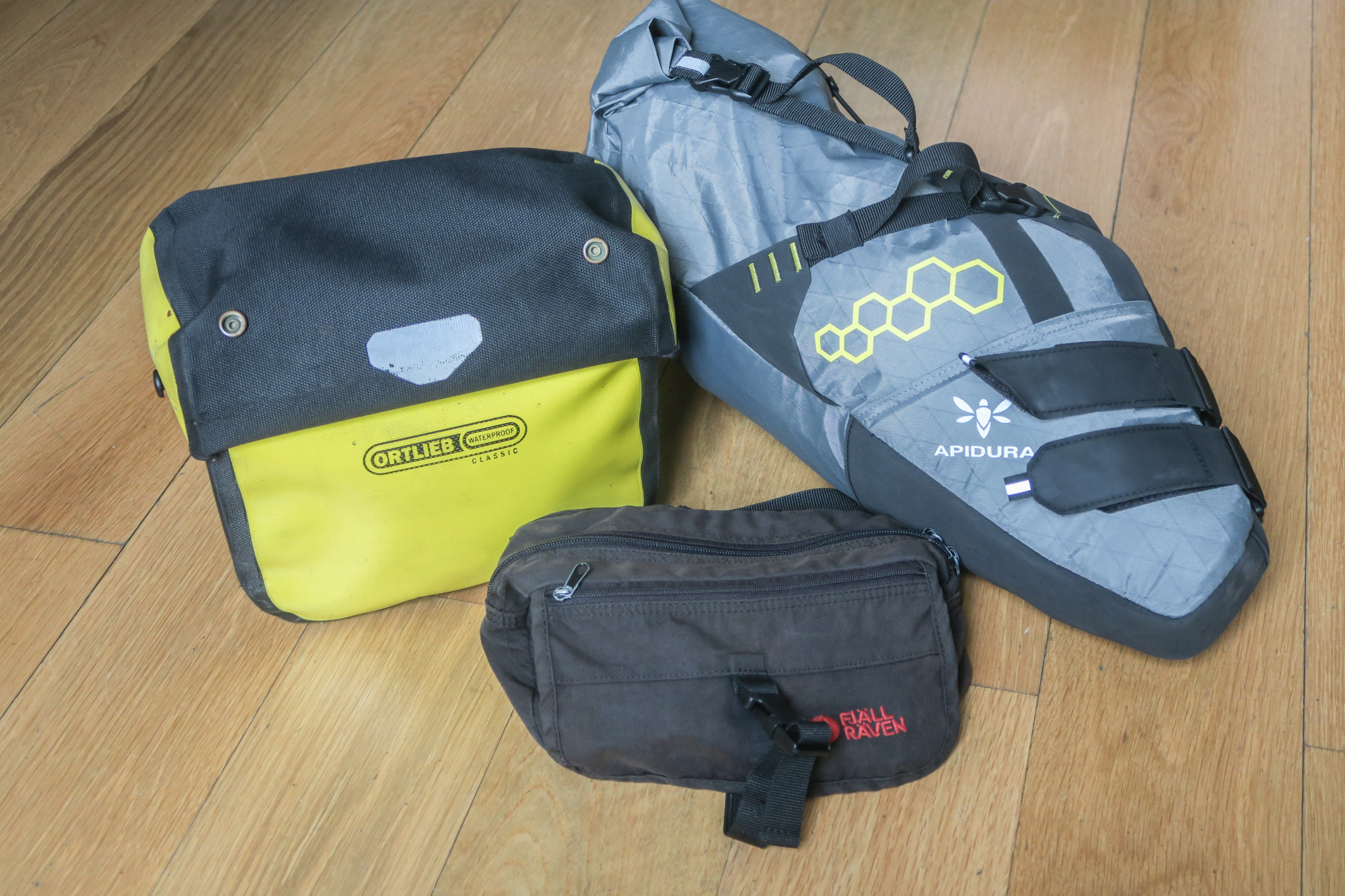
I’ll have three bags on the bike and most probably an additional bum bag. Total weight of the bags is 1.1 kg.

20150726-IMG_1291

Continue reading “Paris-Brest-Paris 2015 – my kit list”

Deep Lee Coroner’s Inquest – A chance missed

This is a guest post by Andrea Casalotti, who attended the inquest on the death of cyclist Deep Lee, who was killed by a lorry at King’s Cross in Oktober 2011.  For a full report of the Inquest, read Paul Foot’s article. These are Andrea’s personal points on some aspects of the Inquest.

The Coroner’s conclusion was “Death caused by road traffic collision”. She considered but decided not to issue a “Prevention of Future Death” (PFD) Report.

The Coroner (who also heard the Inquests of Brian Dorling and Philippine de Gerin-Ricard) conducted the inquest fairly, asking the right type of questions and at one point castigating TfL for waiting for corpses before implementing change. She also concluded that if the Transport Authorities continue to plan roads that put cyclists and HGVs sharing the same space, tragedies like the death of Deep Lee are inevitable.

The Coroner said she is very keen to use PFDs whenever she sees road conditions being a potential cause of future deaths, but she explained that she was not going to issue one in this case because TfL had presented new plans for the junction, which are now under consultation.

Continue reading “Deep Lee Coroner’s Inquest – A chance missed”

London’s bad cycling infrastructure at work

London’s so-called Cycle Superhighways, once a flagship project of mayor Boris Johnson, have been criticized right from the beginning in 2010. Most of the flak  is focussing  on the particularly dreadful Cycle Superhighway 2, where five cyclists died within two years.

But Cycle Superhighway 3, which runs from Barking to Tower Gateway, has flawed bits as well. Yesterday, I gained some first hand experience on how  bad design puts cyclists at risk and annoys motorists who don’t understand the odd layout of the cycle lane.

The flawed spot is on Horseferry Road in Tower Hamlets, which is a one way street. It has a contra-flow cycle lane for eastbound cyclists riding towards the City. The snag is that that cycle lane runs on the right hand side of the road, rather than the left one. The lane is not physically separated from the street and entails a blind turn.

Car drivers who don’t know the layout assume that riders not only go in the wrong way of a one-way street but also think those bloody lycra louts are doing this on the wrong side of the road. A real life example of such a situation can be watched in the video. Unnecessary and potentially dangerous conflicts are imbued in that layout.

A second, related problem is that the cycle lane is too narrow so you can’t safely overtake a slower cyclist, as you can see in seconds 6 to 9 of the video.

This has been an issue for years, as this 2011 comment on Londonist’s website shows:

 “I live in a flat overlooking the CS3 that flows past the T-junction at Branch Road & Horseferry Road in Limehouse. At least once per day, a cyclist runs into a car turning right off of Branch Road onto Horseferry Road one way system (the cycle route runs opposite in the opposite direction to the one-way system).

IT IS A MATTER OF TIME BEFORE SOMEONE IS KILLED OR SERIOUSLY INJURED AT THIS INTERSECTION.”

I guess the reason for this odd layout is that there are parking spaces on the left hand side of the road; and I fully understand that it is of course utterly unacceptable to sacrifice parking space for the safety of cyclists.

Arsenal, Schalke and a bike – cycling from London to Gelsenkirchen

I always love to combine two of my biggest passions, namely football and cycling. Back in Germany, I usually cycle the 28 km / 17.5 miles from my dad’s place to Schalke home games in Gelsenkirchen, the town of my birth in the old, struggeling industrial heart of Germany.

L1010190
Leaving the Emirates….

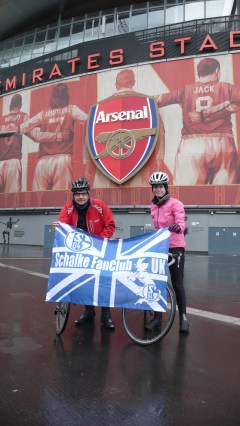
It’s quicker than public transport, you don’t have any parking issues and you can have a beer or two. In early November, my journey to Schalke happened to be slightly longer. On 6 November, Schalke was playing Arsenal in the Championsleague. Shortly after I moved to Highbury two years ago, I also became a staunch Arsenal supporter and was completely thrilled by the prospect that “my”  German team was playing “my” English team. Since I  happened to be in between  jobs in early November I decided to cycle from the Emirates in Highbury to the Veltins Arena in Gelsenkirchen to see the match. Continue reading “Arsenal, Schalke and a bike – cycling from London to Gelsenkirchen”

A black day for the Olympics and cycling in London

Yesterday was a fantastic day for cycling in Britain. In the afternoon, after an astonishing performance in the time trial, Bradley Wiggins won the Gold medal while his Team GB mate Chris Froome got Bronze.

(Wiggos views on road safety are barmy, however.

Update: On Twitter, the Lord of the Cyclists later said his views on helmet laws were misreported: “Just to confirm I haven’t called for helmets to be made the law as reports suggest. I suggested it may be the way to go to give cyclists more protection legally I involved In an accident.”)

However, yesterday was also a black day for cycling in Britain and for the Olympic games. Only a few hours after Brads triumph,  an “Olympic bus” carrying journalists killed a male cyclist on the junction of Ruckholt Road and East Cross Road.

The crash happened at 7.45pm very close to the Olympic Park in East London. The victim is the 10th cyclist who died in a traffic accident in London in 2012 (full details about all cycling fatalities  in London since 2006 are available here).

Update: According to the London Fixed Gear and Singlespeed Forum, the killed cyclist was Dan Harris (@gecko84 on Twitter). On his blog, Dan describes himself as “social media strategist, community manager and web editor” and a physicist by training. Rest in Peace, Dan.

This death makes me very sad and very angry at the same time. The fatality is related to the Olympics in several different ways. The most straightforward connection is that he was killed by an official games vehicle. (Here’s an appalling report by an eye-witness of the crash.)

The bigger story is that the games are making cycling much more dangerous in London. Important and safe cycle lanes around the Olympic Park have been closed due to security (= terrorism) concerns for months. Yesterday’s fatality apparently happened 120 meters beyond entrance to a closed segregated cycle-path, as cyclist Donnachadh McCarthy wrote on Facebook. Continue reading “A black day for the Olympics and cycling in London”

Going to the Olympics? Get on your bike!

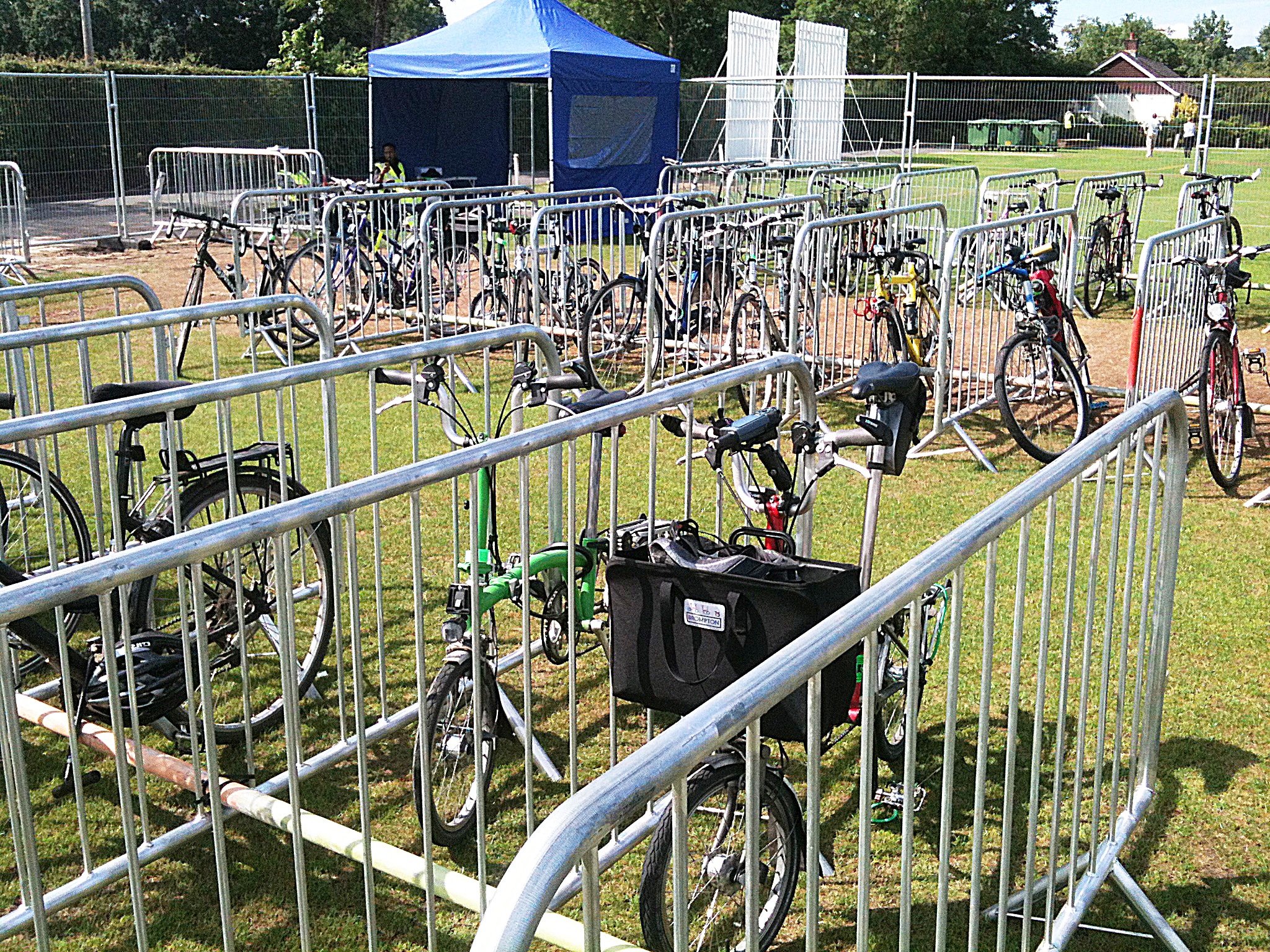
Free and secure: Managed cycle Parking at the Olympics: Wimbledon

Cycling campaigners and influential bloggers have rightly lambasted the organisers of the Olympic Games for not caring enough about the needs of people wanting to cycle to the venues. Especially the closure of the canal footpaths in the proximity of the Olympic Park is outrageous. Getting to the Olympic Park by bike really is a demanding endeavour, as Danny William at Cyclists in the City put it:

“If you want to cycle to the Olympics, you can expect to take a detour, dismount from your bike, cross the motorway, maybe you’ll be able to get back on your bike again after that.”

However, there are alternatives, as Mark explains on his “I bike London” blog who also produced a nice guide for cycling to the Olympics.)

Despite all the justified criticism,  I think cycling to the venues still is a good idea, as I found out yesterday. My wife and I had tickets for the first day of tennis at Wimbledon.

Initially, we planned to take the tube, but then found out that there was supposed to be secure, managed and free cycling parking right next to the venue. Hence, we changed our mind and took the Brommis from Highbury, north London, to Wimbledon, south-west London. Continue reading “Going to the Olympics? Get on your bike!”

How the Velib compares to the Boris Bike – a personal account

Velib', Métro Courcelles, Paris
Velib’, Métro Courcelles, Paris (Photo credit: Wikipedia)

I recently was in Paris for a couple of days. I pootled around in the city using Velibs, the French cousin of the Boris Bike. The French scheme has just celebrated its fifths anniversary.

Since I used both schemes, I thought a subjective comparison might be interesting. (My detailed experiences as a casual user of the Boris bikes are available here.)

All in all, both systems are great but both have their strengths as well as their weaknesses. Overall, however, from the perspective of a casual user I like the Velib scheme more than the Boris bikes.

Let’s compare the different aspects of the schemes one after another.

Terminals

English: Boris Bikes docked at Hyde Park, Lond...
A Boris bike docking station in London (photo credit: Wikipedia)

I found the Velib terminals rather confusing at first sight. They have to different sides, one is apparently for subscribers while the other one is for casual users. It was 1 am when I used the Velib for the first time, and some vin rouge might have been a factor. Be it as it may, initially I was trying to use the side for subscribers and was desperately looking for a credit card slot. I was close to giving up, buy my wife, who had only drunk Perrier, finally managed to figure it out that we have to use the other side of the terminal.

England scores the opening goal: England: 1 , France 0 Continue reading “How the Velib compares to the Boris Bike – a personal account”