But Cycle Superhighway 3, which runs from Barking to Tower Gateway, has flawed bits as well. Yesterday, I gained some first hand experience on how bad design puts cyclists at risk and annoys motorists who don’t understand the odd layout of the cycle lane.
The flawed spot is on Horseferry Road in Tower Hamlets, which is a one way street. It has a contra-flow cycle lane for eastbound cyclists riding towards the City. The snag is that that cycle lane runs on the right hand side of the road, rather than the left one. The lane is not physically separated from the street and entails a blind turn.
Car drivers who don’t know the layout assume that riders not only go in the wrong way of a one-way street but also think those bloody lycra louts are doing this on the wrong side of the road. A real life example of such a situation can be watched in the video. Unnecessary and potentially dangerous conflicts are imbued in that layout.
A second, related problem is that the cycle lane is too narrow so you can’t safely overtake a slower cyclist, as you can see in seconds 6 to 9 of the video.
“I live in a flat overlooking the CS3 that flows past the T-junction at Branch Road & Horseferry Road in Limehouse. At least once per day, a cyclist runs into a car turning right off of Branch Road onto Horseferry Road one way system (the cycle route runs opposite in the opposite direction to the one-way system).
IT IS A MATTER OF TIME BEFORE SOMEONE IS KILLED OR SERIOUSLY INJURED AT THIS INTERSECTION.”
I guess the reason for this odd layout is that there are parking spaces on the left hand side of the road; and I fully understand that it is of course utterly unacceptable to sacrifice parking space for the safety of cyclists.
Maybe this is just wishful thinking. Maybe, however, the 2nd February 2012 might be seen as a historic day for cycling in London when people will look back in a few years.
Today might be remembered as the day when the real cycling revolution in London started.
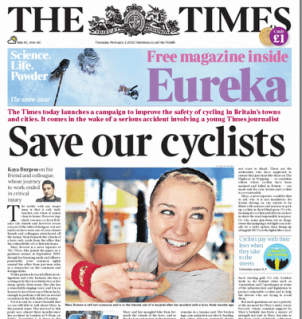
Today, “The Times” , one of the oldest newspapers of the world, kicked off an amazing and impressive campaign to make British cities safer for cyclists. “Safe our cyclists”, the newspaper urged on its front page.
This might be our “Stop de Kindermord” moment.
In the early 70s, in the Netherlands a movement called “Stop de Kindermord” (“Stop the child murder”) campaigned hard for a more cycling friendly road design in the Netherlands. Only these protests lead to an infrastructure that today is the envy of the world and taken for granted by most observers. (David Hembrow has an interesting post about the history of the movement and there is also a good video on Youtube on how the Dutch got their cycling infrastructure.)
“The Times” could not have been timed better. In the last 12 to 18 months, the public anger about the appalling road conditions for pedestrians in London has grown impressively.
Bloggers – first and foremost Danny Williams and Mark Ames – organised a number of demonstrations against car centric traffic priorities, poignant vigils remembering cyclists who died in traffic were held, and ghost bikes for killed cyclists were installed. A new group called “Bikes Alives” organises regular demonstrations at King’s Cross (the next one on 6 February). The topic was discussed in the London Assembly, and a growing number of articles in blogs and traditional news media address the issue.
The University of the Arts London has launched a campaign called “Right to Ride” after Deep Lee, one of its students, was killed by a lorry at King’s Cross last year.
Local newspapers like the Evening Standard and the Camden New Journal report meticulously about cycling related issues and the London Cycling Campaign works on a large initiative called “Go Dutch”.
On top of all this comes the impressive and vocal campaign by “The Times”, triggered by the accident of Times reporter Mary Bowers who was crushed by a lorry in November in front of the newspapers offices in Wapping and has been in a coma until today.
This campaign might be the tipping point.
The fact that “The Times” embarks on the topic proves that cycling has become mainstream. It’s not just the pastime of tree huggers or overly active lads in lycra. It’s an everyday activity that ordinary people do. It’s the fastest, cheapest and most environmentally friendly way to get around in central London. And we have the right to cycle without constant fear.
Due to car centric thinking at Transport for London, this activity is much more dangerous than it ought to be. A lot of things could be improved rather easily (here’s an example concerning Old Street roundabout, where a Boris biker was almost killed by a lorry yesterday). Some fundamental and expensive changes in road design are also necessary.
In an election year, the safety of cyclists has become one of the big issues in London. Until today, Transport for London and Boris Johnson have not taken the issue seriously. They have chosen to ignore the fact that planning priorities and road design are to blame for many deaths and injuries of cyclists.
This approach has become much, much harder to hold up.
The new docking station on Crinan Street / York Way
It is with deeply mixed feelings that I realised a few days ago there will be a new docking station for Boris bikes north of King’s Cross. It will be on Crinan Street right next to King’s Place, where the Guardian resides. It looks like it will be opened soon.
On the one hand side, it’s really good to see the expansion of the cycle hire scheme in the King’s Cross area. The network of docking stations is particularly patchy in this part of the city. Although I’m only a very casual user of the scheme (I prefer to use my own bike) it’s very convenient to have a docking station right next to my office on Crinan Street.
On the other hand, the new docking station really gives me shivers. If you want to use it, you have to ride your bike on one of the most notorious and cycling unfriendly areas of central London – the infamous King’s Cross gyratory.
A TfL representative insisted that introducing a cycle lane at the junction would “cause considerable queues”, stressing that there was “limited time” to conduct a review of the proposed changes for the junction because of a “commitment” to make them in time for the Olympic Games.
The new docking station north on York Way will lure Boris bikers to an area that is loathed even by very experienced cyclists. Many of them are tourists or otherwise inexperienced cyclists who are not familiar with the bewildering system of one-way streets around King’s Cross and are not aware of the build in dangers for cyclist on the roads around King’s Cross. To quote an infamous sentence by Boris Johnson, they will find is amazingly difficult “to have their wits about them”.
There are no bike facilities on York Way whatsoever and cycling there is absolutely counter intuitive. Between Euston Road and Wharfdale Road, the left lane is used as a bus stop. Northbound cyclists who keep left happen to be squeezed in the middle of the traffic: busses on their left, fast moving cars and lorries on their right.
I cycled there quite often and came to the conclusion that the “safest” way to ride there is if you position yourself on the road like a cyclist in Europe would do: I keep on the outer right lane next to the curb.
However, if you want to carry on north behind Wharfdale Road, you have to cross two lanes of car traffic because York Way ceases to be a one-way street there. To get to the docking station on Crinan Street, you have to cross York Way with its four lanes of fast moving, aggressive drivers. (The better way to get to the docking station is a right turn onto Wharfdale Road and then a left into Crinan Street, but tourists and people not familiar with the area won’t know.)
I consider myself an experienced cyclist who tends not be scared easily but I always feel extremely queasy when I cycle on York Way. I usually use Pancras Way as an alternative to York Way . However, this tiny street between King’s Cross Station and St. Pancras Station currently quite often comes closer to a car park for cabs than a street. In peak hours, it is almost impossible to cycle there at all. On top of that, Goods Way north of St. Pancras currently is a one way street in eastern direction and you have to cycle illegally on the curb if you want to get to King’s Place.
Leaving the docking station on Crinan Street by bike is a similar nightmare since you can’t use the York Way south of Wharfdale Road. Imagine you cycled to the docking station on Crinan Street and find out it is full. If you’re not aware of Pancras Street, cycling back to the docking stations south of King’s Cross resembles a very personal “Tour du Danger”.
All in all, the docking station on Crinan Street makes the case for segregated cycle lanes in the area even more compelling. Anything else would just be irresponsible and a gamble with human life.
“My girlfriend Deep Lee (Min Joo Lee) was killed in a car accident at the junction of York Way and Gray’s Inn Road on 3rd of October, 2011. I have submitted this email as I would like the council to consider this junction as extremely dangerous for cyclists and consequently needs some immediate improvements made to protect local residents to prevent a similar accident happening again.
The issue with the road where my girlfriend was killed by the lorry is that there is no cycle lane and the road is too narrow to share the space with both cars and cyclists. Therefore cyclists are forced to be extremely close to vehicles and it is difficult for them to be seen from large trucks.
My girlfriend was just in front of the truck and both her and the truck driver were waiting for the traffic signal to change.
The driver of the truck might not have been able to see her directly and he appeared not to have looked forward using
the mirror which is placed to see just in front of the car around bumper. Consequently Deep was run over.
I would like the Council to consider making the road safer and implementing changes such as providing cycle lanes like those used in the Netherlands or making selected roads safer for cyclists and informing cyclists to use these roads.
With the number of cyclists on the roads increasing all the time (and with the college of Central Saint Martins, where Deep attended) recently having moved to King’s Cross, I am keen to prevent similar accidents happening again in the future.
This, combined with an increased number of trucks being used to construct the Olympics sites and prepare London for the games makes the risk all the greater.
I would like to urge the council to take some immediate action to improve the road layout for cyclists before more accidents happen and more cyclists are killed.
Your sincerely,
Kenji Hirasawa”
The junction where Deep Lee died has been heavily criticised by road safety experts and local pedestrian and cycling campaigners for years. A 2008 report commissioned by TfL came to the conclusion that the whole area was highly dangerous and should be re-designed.
However, TfL did not heed that advice. Smoothing the traffic flow for motorised vehicles was deemed more important than the life of cyclists.
In an appalling statement, this was blithely acknowledged by a representative of Transport for London admitted in a hearing at Camden Town hall, as the Camden New Journal reported:
A TfL representative insisted that introducing a cycle lane at the junction would “cause considerable queues”, stressing that there was “limited time” to conduct a review of the proposed changes for the junction because of a “commitment” to make them in time for the Olympic Games.
Early next year, TfL plans to make some changes at the junction. However, they do not address the fundamental issues at all. James Thomas, the maker of the memorial bike for Deep Lee, had a close look at the plans and concludes that there are
“no improvements in safety for cyclists.”
This is where Deep Lee died - TfL plans no changes to the junction (drawing by James Thomas)
In an email to TfL, James wrote:
” Your proposals at that junction in the direction [Deep Lee] was travelling, amount to a decision to repaint the existing cycling box!
This completely ignores the problem that there are two lanes of traffic, including many HGV vehicles, entering that junction from Grays Inn road. At that junction the road narrows, so vehicles jostle for position and they also turn through 45 degrees, with the added distraction of many people crossing the road, cyclist end up being crushed under the wheels of HGVs.
That is what happened to Deep Lee.
In 2012 and foreward there will be many more pedestrians crossing the street, more and more cyclists and HGVs servicing the Kings Cross site for another 5+ years.
I warn you that the likely consequence is that more cyclists will be killed. If that is the case and with TFL ignoring their own study into the junction from 3 years ago, which suggested that real safety improvements should be made, then I believe TFL and the mayor are being negligent in ignoring this issue and should be wary of the case of corporate manslaughter that has already been suggested.”
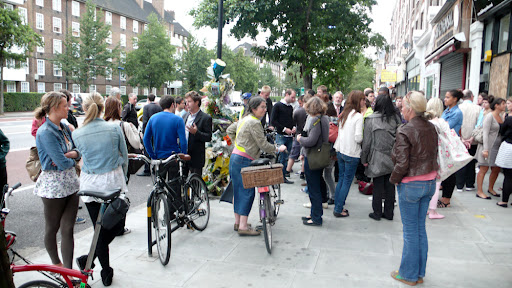
Tonight at 6.30pm, about 60 people gathered on a narrow pedestrian island at King’s Cross, central London. Surrounded by horrific traffic – I was really afraid that somebody might get hit by a car – we all commemorated Deep Lee (Min Joo Lee), the 24 year old cyclist who died at this spot three weeks ago after she was hit by a lorry.
James Thomas, who build the bike (left) , and a good friend of Deep Lee (right)
Deep Lee’s best friend gave a very moving speech. It was a poignant and sad ceremony that gave me the shivers. I hope that the bike will work as a reminder for all road users to respect each other and take care. It might also wake up Transport for London that a human-friendly redesign of the roads in the area is urgently needed.
Many thanks again to James Thomas, a cyclist working a few hundered yards away and to Beth (I don’t know her last name) James organised the bike and painted it. Beth, a designer, worked on the sign.
James explained his motivation in an interview with Will Perrin that is available here. I was happy that I could help with spreading the word. The whole initiative was organised informally by people over the internet who did not know each other. (Big society, here we come!) I’m really impressed by this amazing civic spirit.
On 3 November, there will be a memorial service at On 3 November, there will also memorial ceremony for her at the university. It starts at 6pm at Central Saint Martins College of Arts and Design ( Granary Building, 1 Granary Square London N1C 4AA)
“London Assembly Member John Biggs said he twice met with Transport for London officials over concerns with the Bow Flyover.
However, he was told there was no obvious solution which would not cause massive traffic delays. Mr Biggs said he had the same response in a written question to London Mayor Boris Johnson.”
Few details are publicly known about the crash at the moment and we should not jump to conclusions. The police is looking for witnesses – if you saw something, please get in touch with the Road Death Investigation Unit at Alperton on 0208 998 5319.
This is a guest post by LindaH, who was the first one to write about the sad and fatal accicent in Lambeth last month here Johanna Bailey died. Although campaigners of London Cycling Campaign identified the road where the accident happened as dangerous in 2008 and numerous cyclists on online forums share this view, Transfort for London (TfL) apparently does not see any need for action, as Linda reports. Let’s help to convince them.
Help please!! Following the death of cyclist Johannah Bailey on 31 July, a meeting with TfL officials has been arranged to press for improved safety measures for cyclists in the area of Cycle Route 5 where she died. The meeting is scheduled for 12 September.
Johanna Bailey cycled this way – the spot where she dies comes after about 10 or 11 seconds, where the collision investigators’ markings are in the middle of the road. (video courtesy of “Origamist“)
TfL officials say their work is “data led” — essentially, not enough people have died or had life-changing injuries for them to take action. Having secured a meeting with them nonetheless, it is crucial that we present as much evidence as possible to show why changes here are essential. The police also have asked for copies of correspondence into safety issues here, which they will include in their collision investigation report. Police reports can mandate changes to areas deemed unsafe.
The accident site seen from the opposite direction, seconds 14 and 15. Again, the video was made by “Origamist“.
We need to collect as much evidence as possible to strengthen our case. Have you – whether as a cyclist, driver or pedestrian — seen or experienced near misses in this area? Have you had or witnessed an accident which went unreported?
The area under discussion is the South Circular from the junction of Rudloe and Poynders Road SW4 through to the turnoff from Cavendish Road into Klea Avenue. It includes all the entry and exit points to the area: Cavendish, Hazelbourne, Englewood and Abbeville Roads, and Klea Ave as well as the housing estate entrance.
It was completely heartbreaking and very unsetteling. Sam’s family and a lot of his friends showed up trying to cope with the unexpected loss of a loved one.
According to various press reports, Sam was cycling southbound on Holloway road. Right in front of Holloway Cycles slightly north of the junction with Jackson street a door of a parking car was opened (apparently by a child) and hit Sam. He came off and was immediately afterwards run over by a TfL, as the Camden New Journal reports.
This is the second fatality in seven days. At least 12 cyclists died in the capital in traffic accidents in 2011, plus at least two more in just outside of the boundaries of Greater London (details of all fatal crashes since 2006 here) ashes here: moves me especially because I live literally around the corner.
My personal lesson from this tragic incident is: Keep away from the door zone! I’m trying to pass parking car with enough distance so open doors don’t hit me. I’m also trying to avoid busy roads like Holloway road as much as possible. Most severe crashes involving cyclists happen there. Cycling on quieter roads is possible most of the time. Sometimes, this means taking a slightly routes and it takes a few minutes more. However, less traffic mean fewer vehicles that can possibly kill you.
The big lesson for drivers is: Do a shoulder check before getting off a car. And please, please, put the child safety lock in action when you’re driving around with kids.
The police is still looking for witnesses of the crash. Please call the Road Death Investigation Unit at Alperton (0208 998 5319). The police wants to talk to passengers who were on the 153 bus involved in the collision.




 Cycling Intelligence