Cyclists, busses and the unsettling death of Jayne Helliwell

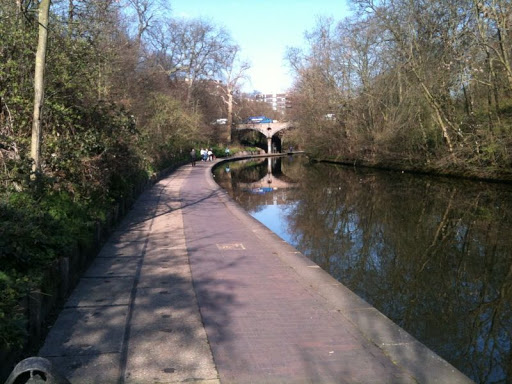
TfL busses in central london

About 10 to 20 cyclists die on the streets of London each year. Almost all of them are killed by motorised vehicles. Quite often, the drivers are charged with dangerous driving and have to face an inquest. The results of these inquests, however, are frequently very depressing.

The latest example is the death of Jayne Helliwell, a 25 year old student who died on Oxford Street last April. She was crushed to death by a TfL double decker because the driver incidentally hit the accelerator instead of the break. (There are two heart breaking orbituaries written by friends and colleagues of her: here and here.)

And guess what? He was recently acquitted. The case against the driver named Carlton Lewars was dropped after it was revealed that Lewars suffers sciatica. According to a report in the Evening Standard, he claimed that he suffered a “sudden pain” immediately before his bus hit Jayne. Allegedly, this pain was the reason why he used the wrong pedal.

I’m not expert in law, generally I do trust the British judicial system and I think the presumption of innocence rightly has to be applied if there are any reasonable doubt left. So let’s assume that the “not guilty” decision by the judge was correct.

Nevertheless the whole case is deeply unsettling. The company employing Carlton Lewars – Metroline – knew about his illness but allowed him to stay behind the wheel anyway. The “Evening Standard” quoted a Metroline spokesman stating that Lewars had been declared fit by his GP and the illness did not revoke his bus driving licence.

To me, there seems to be a significant hole in the system. How is it possible that an illness does not render somebody unfit to do his job, but when he makes a grave mistake due to this illness, he’s not responsible for his behaviour?

Either his GP (hughly unlikely) , Metroline and/or Transport for London has to take responsibility, in my humble opinion. Metroline employed an ill man who was unfit to drive a bus safely and hence killed an innocent cyclist.

Looks more scary then they are - if the driver is fit.

The “Evening Standard” quoted the Metroline spokesman saying how deeply sorry they are about the death of Jayne. Well, fair enough.

But how about putting your money where your mouth is? Because of your hiring decisions and employment policies, you’re indirectly responsible for the death of Jayne Helliwell. You knowingly employed somebody who due to his illness wasn’t able to do his job properly.

Please don’t get me wrong: I don’t want to blame TfL bus drivers in general. In fact I do have a very high opinion about them and thing the vast majority of bus drivers in London are doing an amazingly good job. My personal experience as a cyclist is that almost all TfL busses are driven in a very considerate and careful manner (of course, as always in life, there are exceptions).

LCC’s “London Cyclist” magazine has recently done an interesting story on the cyclist awareness training for bus drivers. I think this is really paying off.

According to my statistics on severe cycling accidents in London only two other cyclists have been killed by TfL busses since 2006 (a male cyclist on Park Lane in February 2008 and Dorothy Elder on Southampton Row in November 2009. The driver who killed Dorothy was also acquitted, later. Freewheeler wrote a good post on that disturbing decision, and I commented on his post.)

This compares to a total of 82 cyclists, the big majority killed by lorries and vans. The low numbers of cyclist killed by bus drivers is even more remarkable given the fact that TfL busses probably significantly outnumber lorries on the streets of London, the job is very stressful and the pay isn’t fantastic.

Nevertheless, Jayne’s death and the revelations from the inquest are deeply unsettling. Hence, I urge Metroline and TfL to take responsibility for Jayne’s death. Pay a comspensation to her family and donate some funds to the London Cycling Campaign. However, even more important is a tightening of the employment rules. Otherwise, the message to any driver in London is straightforward: Convince your GP to diagnose you with sciatica. That’s the perfect insurance policy against any possible wrongdoing.

Update: On 2 November 2011 there was in inquest into Jayne’s death. The “Camden New Journal” published a brief report.
Car free Cycling in London: North Circular

Carfree cycling in London: Finsbury Park

I’ve moved from Düsseldorf in Germany to London in October 2009. One of the things I’m missing most are my after-work rides on the bicycle. In the center Düsseldorf – a city which is normally not known for its cycling credentials – it was fairly easy to do a 15 or 20 miles bike ride without almost any car traffic. All you had to do was getting to the river Rhine.

(The GPS Track is also available here.)

Continue reading “Car free Cycling in London: North Circular”

King’s Cross / St. Pancras: Accidents waiting to happen

According to my hand collected data, eight have been killed by cars and lorries in Greater London in 2011 so far (not five, as the BBC claims). The latest victim was Paula Jurek (20) in Camden last week who was crushed by a left turning lorry.

It might be only a question of time until someone gets hit at King’s Cross / St. Pancras. There is massive construction work going on around King’s Cross at the moment, probably in preparation of London 2012. Some traffic obstructions are inevitable, of course.

However, appartently the companies working on the construction sites don’t care at all for cyclists. I took this picture a few minutes ago at the junction of Pancras Road and Euston Road.

Pancras Road has an Advanced Stop Line for cyclists which is disregarded by both drivers. When I dismounted to take the picture, only the black HGV on the left had entered the box. The tractor (which was pulling a dreadful trailer and was turning left) arrived later. Both vehicles came from the construction site at King’s Cross.

I had a brief – and friendly – conversation with the driver of the tractor after I took the picture. I hold him that he was standing in a bike box. He looked at me in utter disbelief and did not understand what I was telling him.

This is really a shame. Unfortunately I don’t know who is responsible for the construction work at King’s Cross. Is it Transport for London? They urgently have to teach basic cycling awareness lessons to the HGV drivers working there. Otherwise some cyclist will get hurt sooner or later.

Why Norman Baker is right about cycling helmets

Me and my helmet

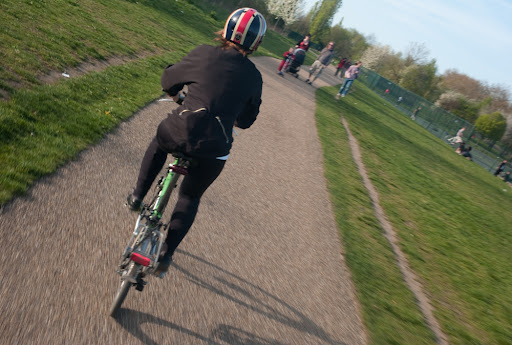
The question if cyclists should wear a helmet is one of the most contentious among cyclists. I usually wear one, as the picture taken on a bike trip in Sweden in 2006 proofs. However, I absolutely think that this should be the personal decision of any cyclist. No cyclist should be forced to wear a helmet.

I’m glad that Norman Baker, the UK minister responsible for cycling shares my view. According to the Guardian, Baker, who is a keen cyclist himself, has recently said:

“I don’t wear a helmet when I cycle. The first reason is that I don’t want to. I don’t want to wear something on my head. For me the joy of cycling is to have the wind in your hair, such as I have left. It’s free, it’s unencumbered; I don’t want to be loaded down.

“It is a libertarian argument. The responsibility is only towards myself. It’s not like drinking and driving where you can damage other people. You do no harm. I’m not encouraging people not to do this, I’m just saying I make a decision not to.”

I think he is absolutely right. But what has happened to poor Norman Baker after his remarks? He got scolded, as the Guardian reports. The paper quotes Joel Hickman, spokesman for  the road safety charity Brake:

“Last year, over 17,000 cyclists were injured on UK roads with over 2,500 killed or seriously injured. The vast majority of these deaths and serious injuries were the result of a head injury. This is precisely why many of our international and European partners have already introduced compulsory helmet wearing. Ministers should practise what they preach and when a minister directly responsible for cycling safety refuses to wear a cycle helmet, we then have to look at their suitability for the role.”

I don’t doubt that a helmet increases the safety of a cyclist. However,  Hickman is beating  a strawman, in my humble opinion. At least here in London, helmets would not have prevented most of the cycling fatalities. The biggest danger here are not head injuries but lorries. As my data on cycling accidents in London since 2006 shows, between 2009 and 2011 at least 51% of the 31 fatal cycling accidents involved lorries. According to an academic paper by Andrei Morgan et al. between 1996 and 2010 (“Deaths of cyclists in London: trends from 1992 to 2006“) “freight vehicles were involved in over 40% cyclists killed”.

You can wear the best helmet in the world – unfortunately it does not help you at all when you’re crushed by a left turning lorry which does not have proper mirrors.

Continue reading “Why Norman Baker is right about cycling helmets”

The troubling death of Dorothy Elder -Comment

Freewheeler, who runs the blog “Crap Cycling & Walking in Waltham Forest”has written a very good post on the death of Dorothy Elder, a cyclist who got killed by a TfL Bus in London in 2009. Last week, the bus driver was cleared in court. Freewheler rightly points to some oddities of the crash and the verdict.

Unfortunately, I’m unable to add a comment to Freewheeler’s blog. Hence I do it here.

The crash happened on 11/11/2009 at 11pm.  According to the Evening Standard, the bus was waiting in front of red lights in Theobald’s Road in the middle lane and was bout to turn right into Southampton Row.  Dorothy passed the (standing?) bus on the vehicles nearside. When she was in front of the bus, she changed landes, apparently without looking or putting her arm out to indicate.

In court, a road crash expert named Barry Wheeler cleared the driver Leola Burte. He said

  1. there may have been a three-second window for Leola Burte to spot Ms Elder become a hazard
  2. however, the driver  would have been focusing on the more immediate traffic dangers to her right
  3. the view of the cyclist may have been obscured by a combination of the cab fittings and windscreen wipers
  4. The prosecution  suggested that Miss Elder should have worn more visible clothing and should not have ridden in front of the bus  in the first place

There are a number of things that deeply irritate me.

Three seconds is quite a long time.  Dorothy was either in front or to the right of the bus. Even according to Mr. Wheeler the driver would have been focusing on the things which were happening to her right. I don’t understand how this can be used an an argument in favour of the driver.

How can windscreen wipers obscure the view of a bus driver? If this is really a valid point, busses should urgently be re-designed. If the view was really obscured, why does Mr. Wheeler stress that Dorothy did not indicate? If the  driver really was unable to see the cyclist, this would not have helped anyway.

The verdict really is surprising given the fact that – according to an interview the bus driver gave to the Evening Standard after the verdict, even the bus company was convinced that the accident was the drivers fault.  According to the Standard,  Leola Burte said:

“I went into the office and they [the bus company Metroline] told me they had seen the CCTV and that I was at fault. I was treated like a murderer. They told me I was sacked and to give back my uniform.”

This is really peculiar. Either Metroline really is an utterly awful employer which does not protect its employees at all or the CCTV recording was very straightforward. Freewheeler makes another good point:

If the collision was captured on CCTV (…)  it is far from clear to me why there should be any room for doubt as to how long the cyclist was visible in front of the bus. This would be a matter of record, not speculation.

Freewheeler rightly points to the fact that at the same junction another cyclist was killed one year earlier.

All this is really unsettling. Has the jury really done a proper job? I do have some  doubts.

Some issues, but even more fun – my experience as a casual Boris Biker

Boris Bikes - the Barclays Cycle Hire Scheme in London

Over the weekend, some friends from Germany were visiting us. On Saturday (March 26) we took them for a ride on Boris bikes. Since my wife and I only have two access keys (thanks to a design flaw in the Barclays Cycle Hire scheme, but that’s another story), we had to hire two more bikes with a credit card as casual users. We had a terrific day and our visitors absolutely loved cycling in London. We cycled more than 15 miles which was great fun (and quite cheap compared to using the tube)

However, unfortunately there are still a number of glitches and inconveniences which should be rectified by  Transport for London (TfL) and Serco, the company which is running  “Barclays Cycle Hire” on behalf of TfL. Hence, I want to share our experiences. Those are my insights:

Casual access finally works

This may sound like stating the obvious, but it isn’t. Officially, the  scheme has been open for casual users since December 2010. However, when I tried to hire bikes for some friends in early January, the system declined several German Visa cards. On the Boris bike forum there are quite a few horror stories (another one)  about casual usage. But believe it or not, on several occasions we really managed to hire two bikes using a German credit card last Saturday!

The hiring procedure is a little bit clumsy

Unfortunately hiring a bike as a casual user is more complicated than TfL suggests. When you’re buying your access period (1 Pound for 24 hours), you have to insert your credit card twice. On the first occasion, the system just checks if you’ve already bought an access period. Then you have to click through several pages of terms and conditions and answer several questions (how many bikes? and so on) on the touch screen. When you’re finished you have to insert your credit card again – now you’re finally charged. I found this a little bit confusing. Pointing this out more clearly at the terminal might be a good idea. Interestingly, we did not have to enter the pin number (we used a Visa debit card issued by a German bank).

Some confusion regarding the release codes

After you’ve bought the access period, the system asks if you want to hire a bike right now. Yes, indeed. The terminal then prints a five digit release code which you have to type in using the number pad at the docking point. (When you hire another bike in the same access period, you just have to enter your credit card and get a new access code.)

Continue reading “Some issues, but even more fun – my experience as a casual Boris Biker”

A reply to Celia Walden: You owe Tom Barrett a profound apology

I’ve never heard of Celia Walden* before, but my Google Alert on “cyclist” and “killed” has just drawn my attention to her. She’s the author of just another rant against cyclists which has been published in the “Daily Telegraph”.

Celia is describing a close call with a female cyclist who

swerved into the middle of my lane without signalling. There was no helmet, of course, and no high-visibility gear – which would have marred the whole sunny tableau. The worst accident she could think of was that her skirt might flutter up to reveal a charming pair of white cotton knickers.

In the next paragraph Celia confesses:

basically I loathe all London cyclists. (…) these people live in a fantasy world. (…) Traffic signals don’t apply to London cyclists, up there as they are on the moral high ground with their officially endorsed sense of righteousness. Sociologically, polls have shown that they tend to be a preening, upper-middle class bunch.

The most shocking sentence comes in the third paragraph:

At least she, after a near-death experience with a London bus or the onset of a little light drizzle, will permanently withdraw from the roads.

Apparantly, this Celia Walden thinks that near-death experiences for cyclists are a good thing which teach them a lesson. I wonder what she would tell the father of Jayne Helliwell, 25, who had a more-than-near-death experience with a bus last year (the bus driver was charged with dangerous driving after the crash).

Reading Celias article in a week where another London cyclist has been killed by a lorry is not just unsettling. It’s utterly disgusting. Until today, according to my statistics at least seven cyclists have been killed on London roads in 2011.

Maybe I’m expecting too much from a Telegraph journalist but some research before writing an article might be a nice idea. Well, I’m here to help:

Celia, do you seriously think that Barrett (he commanded a squadron in Iraq and Afghanistan and was awarded an Order of the British Empire), Mason ( he was “notable for his iron chin, stout heart and thunderous punching power”, according to the Telegraph) and Hawkes ( “one of Britain’s leading child protection experts”, listen to him on Radio 4 ) “have lived in a “fantasy world”?

Do you think they deseve to be loathed?

Do I deserve to be loathed?

One thing is for sure: Tom, Gary and Colin have permanently been withdrawn from the roads, if I may use your words.

Celia, I’m really shocked by your degree of callousness. I don’t understand how the editors of the “Daily Telegraph” dare to print such highly cynical stuff.

In the name of Tom Barrett, Gary Mason and Colin Hawkes (as well as all those other cyclists who have been innocently killed and injured by dodgy drivers in London) I expect a profound apology. Otherwise I would conclude that you just think they just got what they deserved.

* That’s why I’ve misspelled her first name as “Celina” in an earlier version of this article.

My spreadsheet with detailed information on fatal cycling accidents in London since 2006: http://bit.ly/cycling-london

My map showing the locations for fatal cycling accidents in London since 2006: http://bit.ly/cycle-crash-map-london

“London Cyclist’s” ridiculous bike reviews

LCC's magazine "London Cyclist"

Having been a CTC member for more than a year, I’ve recently also  joined London’s Cycling campaign (LCC) which boasts to be “largest urban cycling organisation in the world”. I hugely admire their work.

A few days ago, my first issue of the LCC magazine “London Cyclist” arrived (issue February/March 2011 – not to be confused with the great “London Cyclist” blog) In general, it’s really an impressive, professionally made  product.

However, the bike review on page 42/43 really is a shame. My dear colleagues are discussing “‘urban cross’ bikes”. I don’t have a clue what “urban cross” stands for  and “London Cyclist” doesn’t bother to explain it to me.

The teaser of the article says:

“Taking elements from both cyclocross and mountain biking, the new breed of ‘urban cross’ bikes are ideal for commuting, touring, and light off-roading”

Basically, “London Cyclist” seems to talk about bikes for urban use. Commuting, shopping, going to the pub. They’re featuring four different bikes:

Genesis Day01 Alfine” (£ 999,99), “Jamis Bosanova” (£ 700), “Kona Honky Inc” (£ 1199,99) and “Marin Toscana” (£999).

When I was searching for the bikes on the internet, I was a little bit surprised. For the first three bikes, the Evans bike online shop is among the top search results on Google, and for “Marin Toscana cycle” Cycle Surgery is ranked very high. Pure chance, certainly. Important advertisers like  leading national bike retailers don’t have any influence on the contents of a non for profit magazine run by a cyclists organisation, do they?

But let’s look at the bikes themselves. All of them have drop bars. Two (the Bosanova and the Honky) come with very small tyres (28 mm). The tyres of the Toscana are 4mm wider, while the Day01 has 35mm. Only one of the bikes comes with mudgards. None has  rack or a hub-dynamo and lights.

Apparently, “urban cross” bikes are road bikes with disk brakes.

So according to “London Cyclist”, what kind of bikes do you need for getting around in London?  Apparently you need a bike that

  1. rides very fast (drop bar)
  2. needs very good roads without potholes (small tyres)
  3. isn’t prepared for rainy days   (no mudguards)
  4. isn’t prepared for carrying any luggage on their bike  (no rack)
  5. doesn’t need a reliable, always ready-to-use lighting (no hub dynamo)

Continue reading ““London Cyclist’s” ridiculous bike reviews”

My own Superhighways (I): Paddington – King’s Cross/St. Pancras

There has been a lot of fuss around the Barclays Cycle Superhighways in London – and a lot of criticism. This is the gospel according to “Transport for London” (TfL).

Barclays Cycle Superhighways are new cycle routes that run into central London from outer London to provide cyclists with safer, faster and more direct journeys into the city. The new routes are clearly marked and easy to follow.

By 2015 twelve of those cycle paths are supposed to be built. Currently two are in operation. However, a lot of cyclists severely criticise the superhighways.

Be that as it may. Here I want to present a different view on the issue. I’m going to present my own personal cycle superhighways. Or, to put it differenly and with an appropriate degree of decency, the real cycle superhighways. Most of them are not running into central London from outer parts of the city but are running across central London – routes that I frequently use on my Brompton.

My personal cycling philosophy probably is different than that of the ordinary London cyclist.  I’m trying to avoid busy “A” and “B” roads as well as large roundabouts asmuch as possible. Both are notorious accident hot spots where almost all fatal cycling accidents happen. I just don’t use them.  Most of the time, that’s amazingly easy. You’ll (almost) never see me on the Old Street roundabout, on Euston Road or High Holborn. I’m constantly looking for routes on quieter roads and trying to avoid those notorious accident hotpots.

Here’s my first example: going from Paddington station to King’s Cross station.

View and download the route ad GPSies.com.

The most straightforward way to go there would be the ring road (Marylebone Road, Euston Road). For cyclists, however, that route is a complete and utter nightmare. The northern ring road is one of the busiest and most congested roads of the city with dozens of bus lines, a lot of lorries and way too many cars. Cycling there is definitely no fun.

However, there is a great alternative which is almost completely car-free. Just use the canal.

Looking for a real cycling superhighway?

Since I’ve moved to London in October 2009 I’ve always been a big fan of the canals for cycling. But it took me almost 1.5 years to realize that there is a direct link between King’s Cross (where I work) and Paddington (where I have to get sometimes to catch a train to Oxford). This route is approximately 1.5 km longer than taking the ring road but it’s MUCH safer (I haven’t seen a lorry at the canal, lately, for instance.)

Today, in the early afternoon, it took me 28 minutes to cycle from Paddington to King’s Cross. The tube takes 19 Minutes, and the highly theoretical travel time by car according to Google Maps is 13 minutes (probably at 3am, that’s doable, in the peak hours I bet it’s more than double). I reckon that taking the canal route adds 6 to 8 minutes to the cycling journey time at most.

From my personal point of view, instead of painting existing cycle paths blue, at least some superhighway funds would have better been invested in upgrading the cycle paths at the canal. Underneath some bridges, for example,  the path is very narrow and should be widened.

Do you have your own personal cycle superhighways? Just tell me, please!

On a rather shaky start – and a brilliant night

Last night, finally, the first Friday Night Ride to the Coast was taking place. For me, it all had started rather awkwardly.

Shadow on the wall

On Wednesday, I realised that I really do need a new handlebar for the Grasshopper. Thanks to  frequent tumbles when I was learning how to ride a recumbent the handlebar got a little bit twisted. I probably could use it for another 10 years, but I don’t take any chances with regard to such vital parts. Alright, I’d always fantasised about doing a night ride on the Brompton. Well, here you go.

Good morning, Essex

The second issue was due to a guy I got to know on the German Brompton forum. He got in touch with me and told me that he was going to be in London in March. I touted the FNRttC and the joys of night riding and, rather unsurprisingly,  he got interested. We were supposed to meet prior to the ride at 10 pm at pub close to Hyde Park Corner. Well. I was there. He wasn’t. At 9.45 pm he sent me a text that he was running late. When the pub was closing at 11pm I still was on my own. I can thoroughly assure  you: There are things more funny than sitting in a London pup on a Friday night, fully dressed in Lycra and sipping on your sparkling water. (Of course, stuff happens but the guy only halfheartedly murmured an unconvincing apology.)

[Question to my English friends: What would you have been done in that situation? At 10.55pm I texted him: “The pub is going to close at 11pm. You guys are clowns. See you at HPC”. Would you consider this rude?]

But anyway. When I got to Hyde Park Corner and had chatted with some so the usual suspects this was quickly forgotten.

Apart from the shaky start the ride was utterly brilliant. I was absolutely delighted and amazed that Andy, a recumbent rider who introduced me to the FNRttC, was on the ride. He’d got clipped by a van recently and suffered quite severe leg injuries. He has been (and will be) the only one in the  history of mankind who did a FNRttC with having a crutch mounted to his bike. Absolutely outstanding!)

Continue reading “On a rather shaky start – and a brilliant night”