I’ve been asked this question on numerous occasions since I started to ride a Brompton two years ago.
I always feel queasy and try to dodge the question because most people would call me insane if they knew about the real price I paid for my bike.
“Well, it’s difficult to say. It really depends on the spec”, is my usual reply. Unfortunately, only very few people are satisfied with such a cagey answer. “You know, they start at about 700 Pounds”, is my second line of defense. People who don’t cycle themselves are usually taken by surprise. “Gosh, are they really so very expensive?!”
Well, I paid twice as much. I don’t think that’s too much money for a very good bicycle. Furthermore, if you look at the matter from a different perspective, the bike effectively comes for free. Even if you take the costs for accessories and maintenance into account.
In January 2010, I paid £1510 for my bike. I chose the ultralight weight version plus a Schmidt’shub dynamo (An ordinary bike without the hub dynamo would have been around £500 cheaper). Later on I added a rack (£114 including Eazy Wheels).
Additionally, since January 2010 I’ve spent about £425 for accessories like a new helmet, the Brompton folding basket, different pedals, and so on.
Maintenance has cost about £135 in those two years (I cycled 5000 miles and service the bike myself.) On top of that, I estimate that I spend about £10 per month (or £240 in two years) on busses and the tube.
If you add things up, my total costs of urban transportation in London in the last two years were £2310.
However, if I’d sell the bike tomorrow, I’d at least get £600 (probably more). Hence, the total costs of having ridden the bike for two years come down to £1720.
Without the Brompton, I would have spent at least £1000 per year on public transport – in the last two years riding the most expensive Brompton on sale saved me almost 300 Pounds.
Of course, similar calculations apply for all other bikes as well. However, notice that I did not spend a penny for a lock because I take the bike everywhere with me and don’t have to worry about bike theft at all.
From now on, I might have a better answer to the question how much I paid for the Brompton: “Less than two annual travelcards for the tube.”
Good news about the cyclist who was run over by a lorry on Victoria Street on Tuesday: According to a post on the London Fixed Gear Forum, he “has had an operation and is hopefully going to be ok though his leg is in a bad way”.
The new docking station on Crinan Street / York Way
It is with deeply mixed feelings that I realised a few days ago there will be a new docking station for Boris bikes north of King’s Cross. It will be on Crinan Street right next to King’s Place, where the Guardian resides. It looks like it will be opened soon.
On the one hand side, it’s really good to see the expansion of the cycle hire scheme in the King’s Cross area. The network of docking stations is particularly patchy in this part of the city. Although I’m only a very casual user of the scheme (I prefer to use my own bike) it’s very convenient to have a docking station right next to my office on Crinan Street.
On the other hand, the new docking station really gives me shivers. If you want to use it, you have to ride your bike on one of the most notorious and cycling unfriendly areas of central London – the infamous King’s Cross gyratory.
A TfL representative insisted that introducing a cycle lane at the junction would “cause considerable queues”, stressing that there was “limited time” to conduct a review of the proposed changes for the junction because of a “commitment” to make them in time for the Olympic Games.
The new docking station north on York Way will lure Boris bikers to an area that is loathed even by very experienced cyclists. Many of them are tourists or otherwise inexperienced cyclists who are not familiar with the bewildering system of one-way streets around King’s Cross and are not aware of the build in dangers for cyclist on the roads around King’s Cross. To quote an infamous sentence by Boris Johnson, they will find is amazingly difficult “to have their wits about them”.
There are no bike facilities on York Way whatsoever and cycling there is absolutely counter intuitive. Between Euston Road and Wharfdale Road, the left lane is used as a bus stop. Northbound cyclists who keep left happen to be squeezed in the middle of the traffic: busses on their left, fast moving cars and lorries on their right.
I cycled there quite often and came to the conclusion that the “safest” way to ride there is if you position yourself on the road like a cyclist in Europe would do: I keep on the outer right lane next to the curb.
However, if you want to carry on north behind Wharfdale Road, you have to cross two lanes of car traffic because York Way ceases to be a one-way street there. To get to the docking station on Crinan Street, you have to cross York Way with its four lanes of fast moving, aggressive drivers. (The better way to get to the docking station is a right turn onto Wharfdale Road and then a left into Crinan Street, but tourists and people not familiar with the area won’t know.)
I consider myself an experienced cyclist who tends not be scared easily but I always feel extremely queasy when I cycle on York Way. I usually use Pancras Way as an alternative to York Way . However, this tiny street between King’s Cross Station and St. Pancras Station currently quite often comes closer to a car park for cabs than a street. In peak hours, it is almost impossible to cycle there at all. On top of that, Goods Way north of St. Pancras currently is a one way street in eastern direction and you have to cycle illegally on the curb if you want to get to King’s Place.
Leaving the docking station on Crinan Street by bike is a similar nightmare since you can’t use the York Way south of Wharfdale Road. Imagine you cycled to the docking station on Crinan Street and find out it is full. If you’re not aware of Pancras Street, cycling back to the docking stations south of King’s Cross resembles a very personal “Tour du Danger”.
All in all, the docking station on Crinan Street makes the case for segregated cycle lanes in the area even more compelling. Anything else would just be irresponsible and a gamble with human life.
“My girlfriend Deep Lee (Min Joo Lee) was killed in a car accident at the junction of York Way and Gray’s Inn Road on 3rd of October, 2011. I have submitted this email as I would like the council to consider this junction as extremely dangerous for cyclists and consequently needs some immediate improvements made to protect local residents to prevent a similar accident happening again.
The issue with the road where my girlfriend was killed by the lorry is that there is no cycle lane and the road is too narrow to share the space with both cars and cyclists. Therefore cyclists are forced to be extremely close to vehicles and it is difficult for them to be seen from large trucks.
My girlfriend was just in front of the truck and both her and the truck driver were waiting for the traffic signal to change.
The driver of the truck might not have been able to see her directly and he appeared not to have looked forward using
the mirror which is placed to see just in front of the car around bumper. Consequently Deep was run over.
I would like the Council to consider making the road safer and implementing changes such as providing cycle lanes like those used in the Netherlands or making selected roads safer for cyclists and informing cyclists to use these roads.
With the number of cyclists on the roads increasing all the time (and with the college of Central Saint Martins, where Deep attended) recently having moved to King’s Cross, I am keen to prevent similar accidents happening again in the future.
This, combined with an increased number of trucks being used to construct the Olympics sites and prepare London for the games makes the risk all the greater.
I would like to urge the council to take some immediate action to improve the road layout for cyclists before more accidents happen and more cyclists are killed.
Your sincerely,
Kenji Hirasawa”
The junction where Deep Lee died has been heavily criticised by road safety experts and local pedestrian and cycling campaigners for years. A 2008 report commissioned by TfL came to the conclusion that the whole area was highly dangerous and should be re-designed.
However, TfL did not heed that advice. Smoothing the traffic flow for motorised vehicles was deemed more important than the life of cyclists.
In an appalling statement, this was blithely acknowledged by a representative of Transport for London admitted in a hearing at Camden Town hall, as the Camden New Journal reported:
A TfL representative insisted that introducing a cycle lane at the junction would “cause considerable queues”, stressing that there was “limited time” to conduct a review of the proposed changes for the junction because of a “commitment” to make them in time for the Olympic Games.
Early next year, TfL plans to make some changes at the junction. However, they do not address the fundamental issues at all. James Thomas, the maker of the memorial bike for Deep Lee, had a close look at the plans and concludes that there are
“no improvements in safety for cyclists.”
This is where Deep Lee died - TfL plans no changes to the junction (drawing by James Thomas)
In an email to TfL, James wrote:
” Your proposals at that junction in the direction [Deep Lee] was travelling, amount to a decision to repaint the existing cycling box!
This completely ignores the problem that there are two lanes of traffic, including many HGV vehicles, entering that junction from Grays Inn road. At that junction the road narrows, so vehicles jostle for position and they also turn through 45 degrees, with the added distraction of many people crossing the road, cyclist end up being crushed under the wheels of HGVs.
That is what happened to Deep Lee.
In 2012 and foreward there will be many more pedestrians crossing the street, more and more cyclists and HGVs servicing the Kings Cross site for another 5+ years.
I warn you that the likely consequence is that more cyclists will be killed. If that is the case and with TFL ignoring their own study into the junction from 3 years ago, which suggested that real safety improvements should be made, then I believe TFL and the mayor are being negligent in ignoring this issue and should be wary of the case of corporate manslaughter that has already been suggested.”
Junction of Madras Place and Holloway Road: New design, old problems
It has been a long and tedious campaign. Pedestrian and cycling campaigners pressured Transport for London for several years to redesign an important crossing of Holloway Road in Islington that was inherently unsafe for pedestrians and cyclists. In 2008, Lisa Pontecorvo was killed by a lorry while wheeling her cycle across the busy street. One year later, a pedestrian was knocked down at the same junction.
After several months of construction work, the new junction was finally opened to traffic several days ago. On their website, Islington Cyclist Action Group (disclaimer: I’m a mostly passive member of them but was not involved in the campaign because I moved to London only later) hails the redesign as
“an unalloyed success story for local campaigners working with Islington council officers and Transport for London (TfL)”
Unfortunately, however, I have to play the party pooper.
I use the junction on a daily basis and am rather dissappointed by the new road layout. It’s is better than the original design, but it still is far from perfect and continuous to be inherently dangerous for cyclists.
The basic problem of the junction still has not been resolved by the redesign. The fundamental issue is related to north bound car traffic on Holloway road. There is way too much empty space between the traffic lights for northbound cars and the crossing for cyclists.
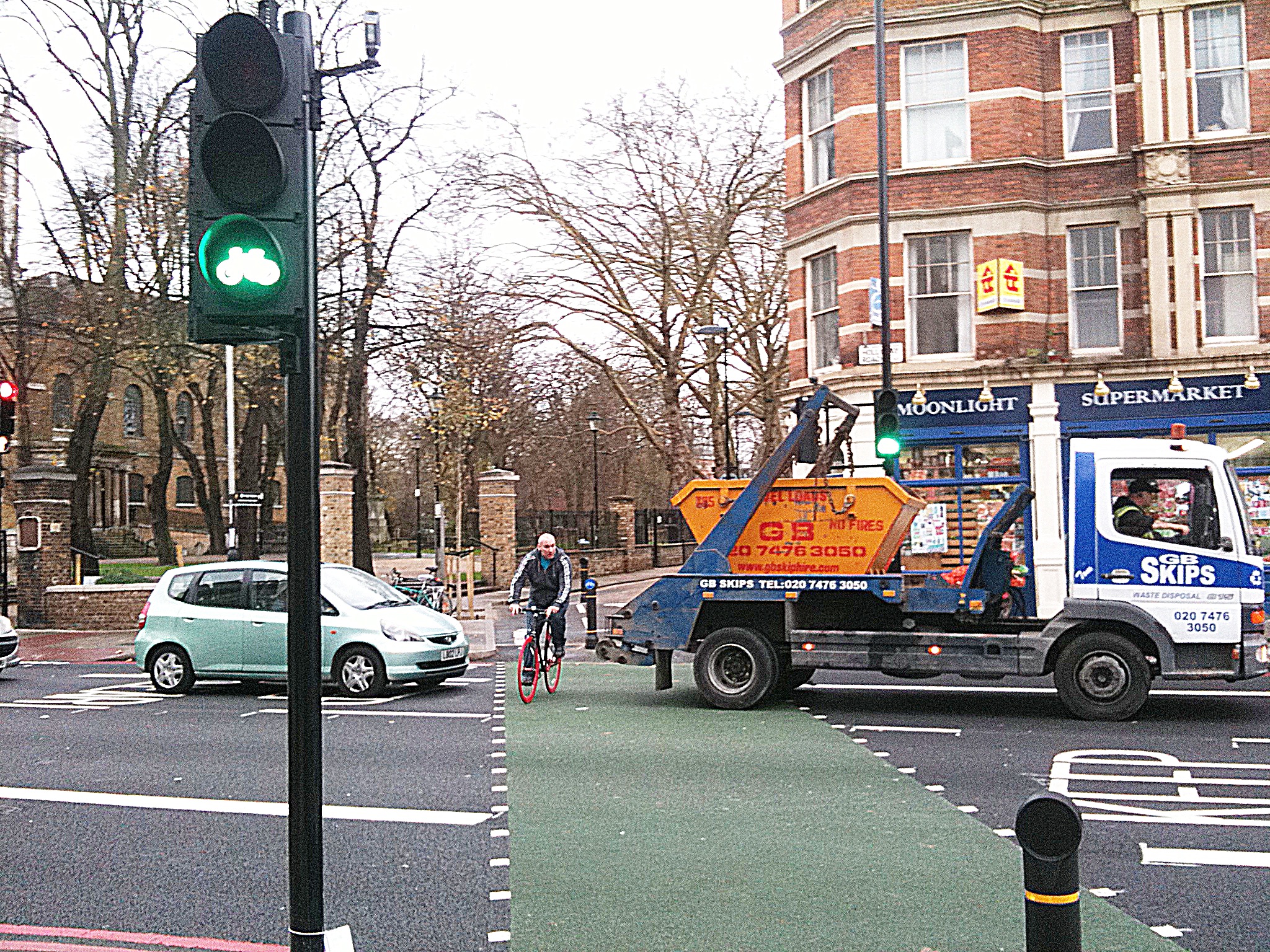
In the peak hours, there are traffic jams on Holloway road. The typical situation, depicted in the picture above, is this: Northbound cars pass green traffic lights but cannot clear the junction due to congestion. Cars queuing in the junction do not realise when the lights change to red for cars and cyclists get a green light. Quite often, in such a moment the car traffic on Holloway road clears slightly and the cars blocking the junction move on. They are on a direct collision course with the cyclists who face a green light at that point of time.
(Update: When I wrote this post I wasn’t aware that there now is a second light for cars about 20 meters further north that prevents the clearing of the northboung car traffic while cyclists face a green light. This, apparently, prevents that the traffic blocking the junction clears while cyclists face a green light. Hence, my initial headline [“Death by design”] appears to be slightly over the top. This is why I removed it.)
The redesign of the junction tried to address this problem but fails to solve it. Nowadays, there is a clearly marked green cycle path across Holloway road and massive “Keep Clear” signs on the street in front of it. Additionally, the space between the lights for cars and the crossing for cyclists has been made smaller (the lights for cars were move a few yards north).
However, despite these measures, Madras Place is still a recipe for disaster. The photo, which I took this morning, shows a typical situation at Madras Place: Cyclists have a green light, but cars queue into the junction. Imagine that the skip lorry moves on – the car will follow suit and conflicts – possibly crashes – with cyclists are bound to occur.
From my point of view, the only permanent solution would be a second, additional traffic light for cars directly in front of the junction so drivers clearly understand that they have to wait while cyclists face a green light.
Otherwise, new accidents at Madras Place are just a matter of time.
At the moment, cyclists still are being confronted with unnecessary dangers at Madras Place and have to take extra care. Use your bell when facing a situation like the rider on the photo and do not ever cross Holloway Road in front of a HGV (you’re in the blindspot of the driver directly in front of a lorry – the driver can’t see you!)
Update: James Candlin just send me the following via the ICAG newsgroup:
Dear Olaf,
I have always said (on this forum and elsewhere) that the only modification which is actually needed is the one which distinguishes North side of the junction from South.
On the north side there is no central suspended traffic light and no repeater traffic light either side where there is one on the South side.
This means any driver heading north in traffic who gets stopped beyond the stop line does not know that the light has turned red for him and carries on as soon as the road clears regardless of the cyclists whom (as ever ) he ignores until too late.
The expensive rejig was wholly avoidable if they had just fitted the lamp on the post which is actually there for the purpose. They could add to the safety by putting up a reminder notice of the cycle lane for motorists or a yellow box junction. Why not put this in your blog too.
Regards James Candlin
Update II: Apparently, TfL already is aware of the remaining problems at the junction. A few days before I wrote this post they met with cycling and pedestrian campaigners and discussed further improvements. Let’s see how things pan out.


 Cycling Intelligence